Understanding Marpe: Benefits and Techniques
November 18, 2025
Orthodontic Expansion Guide
MARPE Expander: What It Is, How It Works, Benefits & Treatment
MARPE, or Miniscrew-Assisted Rapid Palatal Expansion, is an orthodontic technique designed to widen a narrow upper jaw by combining a palatal expander with temporary skeletal anchorage from small orthodontic miniscrews.
It is most often discussed for late adolescents and adults whose upper-jaw growth is more mature and who may not respond as predictably to a traditional tooth-supported palatal expander.
MARPE can be used to address selected cases of transverse maxillary deficiency, posterior crossbite, dental crowding, and other orthodontic problems related to a narrow maxilla.
Quick Answer: What Does MARPE Do?
- Widens the upper jaw: expansion forces are directed toward the maxillary skeletal structures.
- Uses miniscrew anchorage: temporary orthodontic screws help reduce reliance on teeth alone for support.
- May be used in older patients: MARPE is commonly considered in late adolescents and adults.
- Can help correct transverse bite problems: including selected posterior crossbites and narrow arches.
- May create more dental arch space: expansion can sometimes help address crowding as part of a broader orthodontic plan.
- Is not appropriate for everyone: skeletal maturity, anatomy, periodontal health, and treatment goals must be evaluated.
What Is MARPE?
MARPE stands for Miniscrew-Assisted Rapid Palatal Expansion. You may also see similar terms such as microimplant-assisted rapid palatal expansion or miniscrew-assisted maxillary expansion.
The technique uses a palatal expansion appliance together with small temporary anchorage devices placed in the palate. These miniscrews help transfer expansion forces more directly toward the upper-jaw structures rather than relying entirely on the teeth.
MARPE was developed partly to address the challenge of expanding the maxilla in older adolescents and adults, where traditional tooth-borne rapid palatal expansion becomes less predictable as the facial skeleton matures. Research reviews describe MARPE as an important option for transverse maxillary deficiency in post-pubertal patients.
What Is a MARPE Expander?
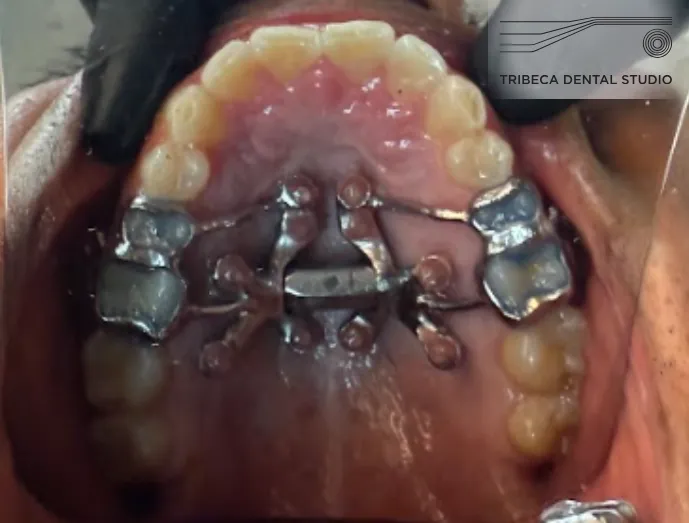
A MARPE expander is an orthodontic appliance positioned across the palate.
Its exact design varies, but it generally includes:
- an expansion screw;
- metal arms or framework;
- connections to selected teeth in some designs;
- and multiple orthodontic miniscrews that provide skeletal anchorage in the palate.
When the expansion mechanism is activated according to the orthodontist's instructions, the appliance applies lateral forces designed to increase the transverse width of the upper jaw.
How Does MARPE Work?
The upper jaw consists of paired maxillary bones joined along the midpalatal region. In younger children, these structures can generally be expanded more readily with conventional tooth-supported appliances.
As skeletal maturity increases, however, achieving meaningful skeletal expansion becomes more challenging.
MARPE uses miniscrews to transfer a greater proportion of expansion force toward the skeletal structures of the palate.
- The appliance is planned: imaging, dental records, and orthodontic evaluation are used to assess anatomy.
- The MARPE appliance is placed: the device is positioned in the palate and anchored using miniscrews.
- Expansion begins: the expansion screw is activated according to a prescribed schedule.
- The maxilla responds: skeletal and dentoalveolar changes can occur as expansion progresses.
- Progress is monitored: the orthodontist evaluates the bite, appliance, teeth, tissues, and expansion response.
- Retention follows: after active expansion, the appliance may remain in place temporarily while tissues stabilize.
Can Adults Get MARPE?
Yes, MARPE is specifically relevant to many late-adolescent and adult orthodontic patients.
Traditional rapid palatal expansion is generally more predictable in younger patients because the facial skeleton is still developing. In adults, a conventional tooth-supported expander may create more dental tipping and less skeletal expansion.
MARPE was developed as a way to increase skeletal anchorage in older patients.
A 2024 scoping review found MARPE to be a viable expansion option particularly in adult patients, while also emphasizing the importance of individual anatomy, treatment planning, potential side effects, and long-term evidence.
Who May Be a Candidate for MARPE?
An orthodontist may consider MARPE when a patient has a true transverse deficiency of the upper jaw and additional skeletal expansion is desirable.
Potential indications can include selected cases of:
- narrow upper jaw;
- posterior crossbite;
- transverse maxillary deficiency;
- dental crowding related partly to limited arch width;
- discrepancy between upper- and lower-jaw width;
- and orthodontic problems where skeletal expansion may improve treatment mechanics.
Not every patient with crowded teeth needs MARPE. Crowding can have many causes, so an orthodontic diagnosis is required before deciding whether expansion is appropriate.
What Are the Potential Benefits of MARPE?
MARPE vs. Traditional Palatal Expander
| Feature | MARPE | Traditional Palatal Expander |
|---|---|---|
| Primary Anchorage | Miniscrews with or without dental support | Primarily teeth |
| Common Age Group | Often late adolescents and adults | Most predictable in growing children and younger adolescents |
| Main Goal | Increase skeletal contribution to expansion | Expansion during growth |
| Dental Tipping | May reduce some tooth-borne effects compared with conventional expansion | Greater proportion of force is transferred through teeth |
| Miniscrews Required | Yes | No |
The American Association of Orthodontists explains that conventional palatal expanders are commonly used while children's jaws are still developing. MARPE extends the concept of expansion by adding skeletal anchorage for selected older patients.
MARPE vs. SARPE: What's the Difference?
SARPE stands for Surgically Assisted Rapid Palatal Expansion.
Both MARPE and SARPE can be considered for transverse maxillary deficiency in skeletally mature patients, but they use different approaches.
| Feature | MARPE | SARPE |
|---|---|---|
| Approach | Orthodontic expansion supported by miniscrews | Expansion combined with surgical assistance |
| Surgery | Generally no jaw surgery as part of the MARPE technique itself | Yes |
| Typical Use | Selected post-pubertal patients suitable for miniscrew-assisted expansion | Patients whose skeletal anatomy or treatment goals require surgical assistance |
| Decision | Requires individualized orthodontic and, when appropriate, surgical evaluation | |
Recent reviews compare MARPE and SARPE as alternative strategies for adult maxillary expansion, with different complication profiles and indications.
Does MARPE Hurt?
Patients can experience pressure, tenderness, or temporary discomfort during placement and the early expansion period.
The experience varies considerably depending on appliance design, miniscrew placement, activation protocol, tissue sensitivity, and individual pain perception.
You may notice:
- pressure across the palate;
- temporary soreness around the miniscrew sites;
- pressure around the nose or upper teeth;
- temporary difficulty speaking clearly;
- changes in eating while adjusting to the appliance;
- and a temporary space developing between the upper front teeth during expansion.
Significant or increasing pain should be reported to the treating orthodontic team.
Why Can MARPE Create a Gap Between the Front Teeth?
A gap between the upper front teeth can develop during successful palatal expansion.
This space, known as a diastema, can occur as the two sides of the upper jaw separate during the active expansion phase.
The appearance of a gap does not by itself determine whether treatment has succeeded, and orthodontic movement may later be used to reposition the front teeth as part of the overall treatment plan.
What Happens During MARPE Treatment?
1. Orthodontic Consultation
Treatment begins with a detailed orthodontic evaluation.
Depending on the case, records can include:
- clinical examination;
- digital photographs;
- intraoral scans;
- dental X-rays;
- and three-dimensional imaging when clinically appropriate.
2. Treatment Planning
The orthodontist evaluates the width of the upper jaw, bite relationship, dental alignment, periodontal condition, bone anatomy, and treatment goals.
3. MARPE Placement
The expander is positioned in the palate and the miniscrews are placed to provide anchorage.
4. Active Expansion
The expansion screw is activated according to the orthodontist's prescribed schedule.
Patients should follow the exact activation instructions rather than changing the schedule themselves.
5. Monitoring
Follow-up appointments are used to monitor:
- skeletal expansion;
- the bite;
- miniscrew stability;
- gum and palatal tissue health;
- tooth movement;
- and overall treatment response.
6. Retention
Once the desired expansion is achieved, a stabilization period is typically required before the appliance is removed or the next orthodontic phase begins.
How Long Does MARPE Treatment Take?
The active expansion phase usually takes place over weeks rather than months or years, but the exact schedule varies substantially depending on appliance design, activation protocol, and the amount of expansion required.
After active expansion, a retention period is needed while the newly expanded tissues stabilize.
MARPE may also be only one stage of a larger orthodontic treatment plan involving braces, clear aligners, or other appliances.
How Long Does a MARPE Expander Stay In?
A MARPE appliance usually remains in place beyond the active turning phase because newly expanded skeletal and soft tissues need time to stabilize.
The exact retention duration depends on the orthodontist's protocol, patient age, skeletal response, amount of expansion, and overall treatment plan.
Do not stop activating the appliance, restart activation, or request appliance removal based only on an online timetable.
Does MARPE Always Work?
No orthodontic procedure has a 100% success rate.
Systematic reviews report generally favorable MARPE success in appropriately selected post-pubertal patients, but the certainty of long-term evidence varies and some studies have important risk-of-bias limitations.
Possible reasons for limited expansion or treatment failure can include:
- advanced skeletal maturation;
- individual suture anatomy;
- insufficient miniscrew stability;
- bone quality or thickness;
- appliance design;
- activation-related issues;
- and other patient-specific anatomical factors.
What Are the Risks and Side Effects of MARPE?
MARPE is still an orthodontic procedure involving skeletal anchorage, and potential adverse effects should be discussed before treatment.
Possible issues can include:
- temporary pain or pressure;
- soft-tissue irritation;
- inflammation around miniscrew sites;
- miniscrew loosening;
- changes in tooth inclination;
- periodontal effects;
- asymmetric expansion;
- failure to achieve the intended skeletal response;
- and the possibility that a different treatment approach becomes necessary.
Recent reviews emphasize that MARPE outcomes and complications can vary considerably with appliance design, anatomy, age, and treatment protocol.
Does MARPE Improve Breathing or Airway Size?
Research has reported increases in certain nasal and airway dimensions after maxillary expansion in some MARPE patients.
For example, systematic reviews have identified measurable increases in nasal cavity width and related skeletal dimensions after MARPE.
Sleep apnea and chronic breathing problems can involve multiple anatomical and physiological factors and require appropriate medical evaluation.
MARPE should therefore be recommended primarily on the basis of an orthodontic diagnosis rather than as a guaranteed treatment for a sleep disorder.
Does MARPE Change Your Face?
Because MARPE changes transverse dimensions of the upper jaw, subtle facial or nasal changes may occur in some patients.
The amount and visibility of change vary significantly and depend on:
- the amount of skeletal expansion;
- age;
- individual facial anatomy;
- soft-tissue thickness;
- and the design and direction of expansion.
MARPE should not be viewed primarily as a cosmetic facial procedure. Its main purpose is treatment of an orthodontic transverse discrepancy.
Can MARPE Be Used With Braces or Aligners?
Yes. MARPE can be one part of a larger orthodontic treatment plan.
After expansion, braces or clear aligners may be used to:
- close temporary spaces;
- align crowded teeth;
- coordinate the upper and lower arches;
- correct bite relationships;
- and refine final tooth positions.
The sequencing depends on the individual treatment plan.
MARPE vs. MSE: Are They the Same?
The terms are related but not always identical.
MARPE is a broad category describing miniscrew-assisted rapid palatal expansion.
MSE, or Maxillary Skeletal Expander, commonly refers to a specific type or design concept of skeletal expander that also uses miniscrew anchorage.
Patients sometimes use the terms interchangeably online, but the exact appliance design can differ between orthodontists and manufacturers.
Can Teenagers Get MARPE?
Yes. MARPE may be considered for selected adolescents, particularly when conventional expansion is less predictable or when greater skeletal anchorage is desired.
However, many younger growing patients can be successfully treated with more traditional expansion methods.
The choice depends on skeletal maturity rather than simply chronological age.
How Do You Clean a MARPE Expander?
Keeping the appliance and surrounding tissues clean is important because food and plaque can accumulate around the expander and miniscrew components.
Your orthodontic team may recommend:
- careful brushing around the appliance;
- using a small interdental brush where appropriate;
- rinsing after meals;
- a water flosser when recommended;
- and attending scheduled follow-up appointments.
Follow the specific hygiene instructions provided for your appliance design.
Frequently Asked Questions About MARPE
What does MARPE stand for?
MARPE stands for Miniscrew-Assisted Rapid Palatal Expansion.
What is a MARPE expander?
A MARPE expander is an orthodontic device that combines palatal expansion with temporary miniscrew anchorage to help widen a narrow upper jaw.
Can adults use MARPE?
Yes. MARPE is frequently considered for late adolescents and adults with transverse maxillary deficiency, although candidacy depends on individual anatomy and skeletal maturity.
Is MARPE surgery?
MARPE itself generally does not involve jaw surgery. It uses orthodontic miniscrews for skeletal anchorage. Some patients may still require surgically assisted expansion if MARPE is not appropriate or successful.
Does MARPE hurt?
Temporary pressure, tenderness, and soreness can occur during miniscrew placement and active expansion. Significant or worsening pain should be reported to the treating orthodontist.
How long does MARPE take?
Active expansion usually occurs over a period of weeks, followed by a retention phase. The complete orthodontic treatment timeline varies by patient.
Why does MARPE cause a gap between front teeth?
A temporary gap can develop as the upper jaw expands. Orthodontic treatment can later reposition the front teeth as part of the overall treatment plan.
Does MARPE change your face?
Subtle changes in facial or nasal dimensions may occur in some patients, but the amount varies and MARPE is primarily an orthodontic skeletal expansion procedure rather than a cosmetic facial treatment.
Can MARPE help breathing?
MARPE may increase certain nasal and maxillary dimensions, but it is not a guaranteed treatment for sleep apnea, snoring, or nasal obstruction. Breathing disorders should be evaluated separately.
What is the difference between MARPE and a regular expander?
A conventional expander relies primarily on teeth for anchorage, while MARPE uses miniscrews to transfer more force toward the skeletal structures of the palate.
What is the difference between MARPE and SARPE?
MARPE uses orthodontic miniscrew anchorage without jaw surgery as part of the expansion technique, while SARPE combines expansion with a surgical procedure.
Is MARPE the same as MSE?
MARPE is a general category of miniscrew-assisted expansion. MSE is commonly used to describe a particular skeletal-expander design within the broader concept of miniscrew-supported maxillary expansion.
MARPE and Palatal Expansion in Tribeca, NYC
MARPE can be an important orthodontic option for selected adolescents and adults with a narrow upper jaw or transverse maxillary deficiency.
The most important step is determining whether the problem is truly skeletal, how mature the palatal structures are, and whether MARPE is the most appropriate form of expansion for the individual case.
At Tribeca Dental Studio, orthodontic evaluation can include assessment of dental alignment, bite relationships, jaw width, airway-related concerns when relevant, and options for comprehensive orthodontic treatment.
Considering Palatal Expansion?
Schedule an orthodontic evaluation to determine whether MARPE, another palatal expander, or a different orthodontic approach may be appropriate for your treatment goals.
Book an Appointment