Fixing a Narrow Palate Without the Stress
April 3, 2026
What Is an Orthodontic Palate Expander — and Do You Need One?
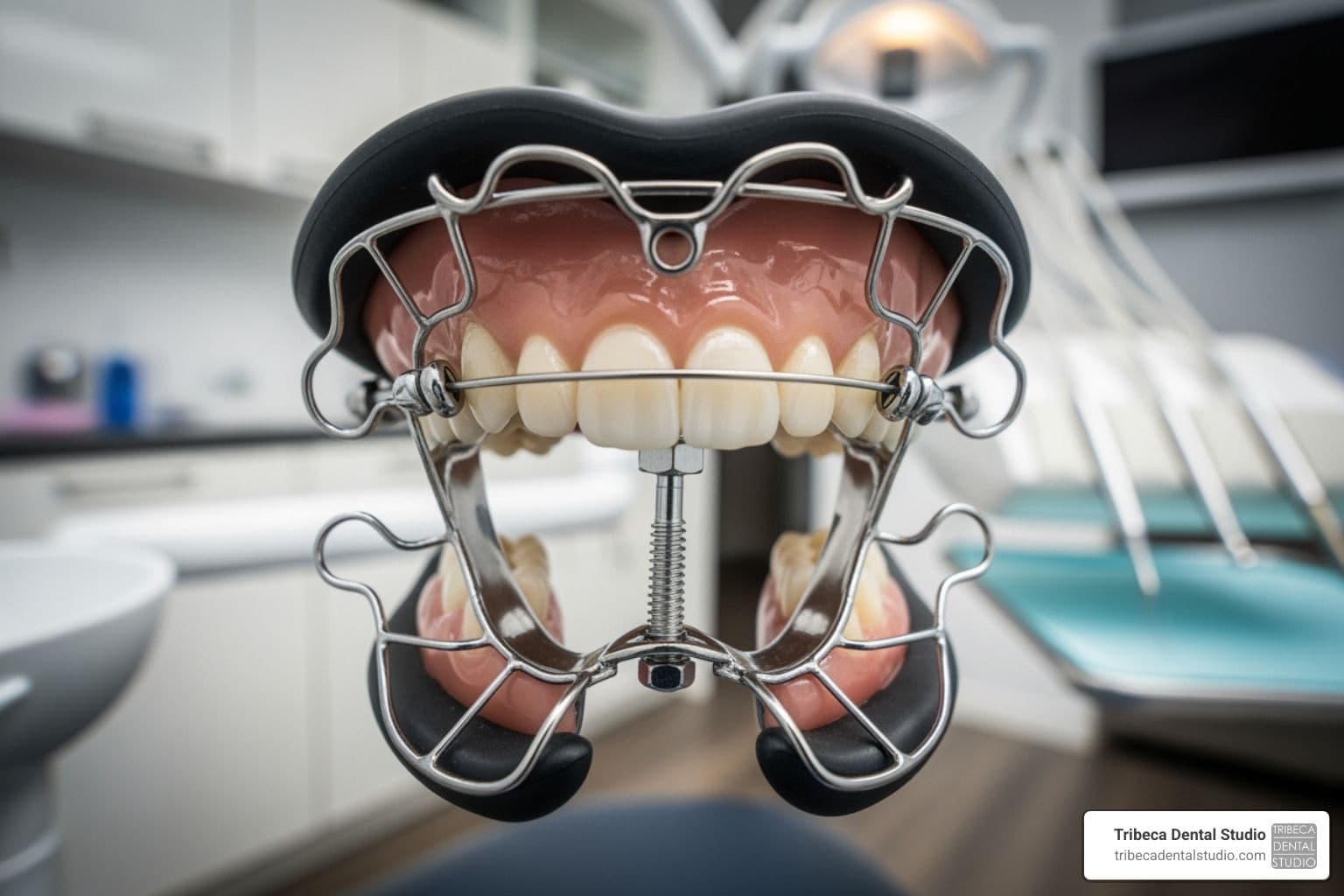
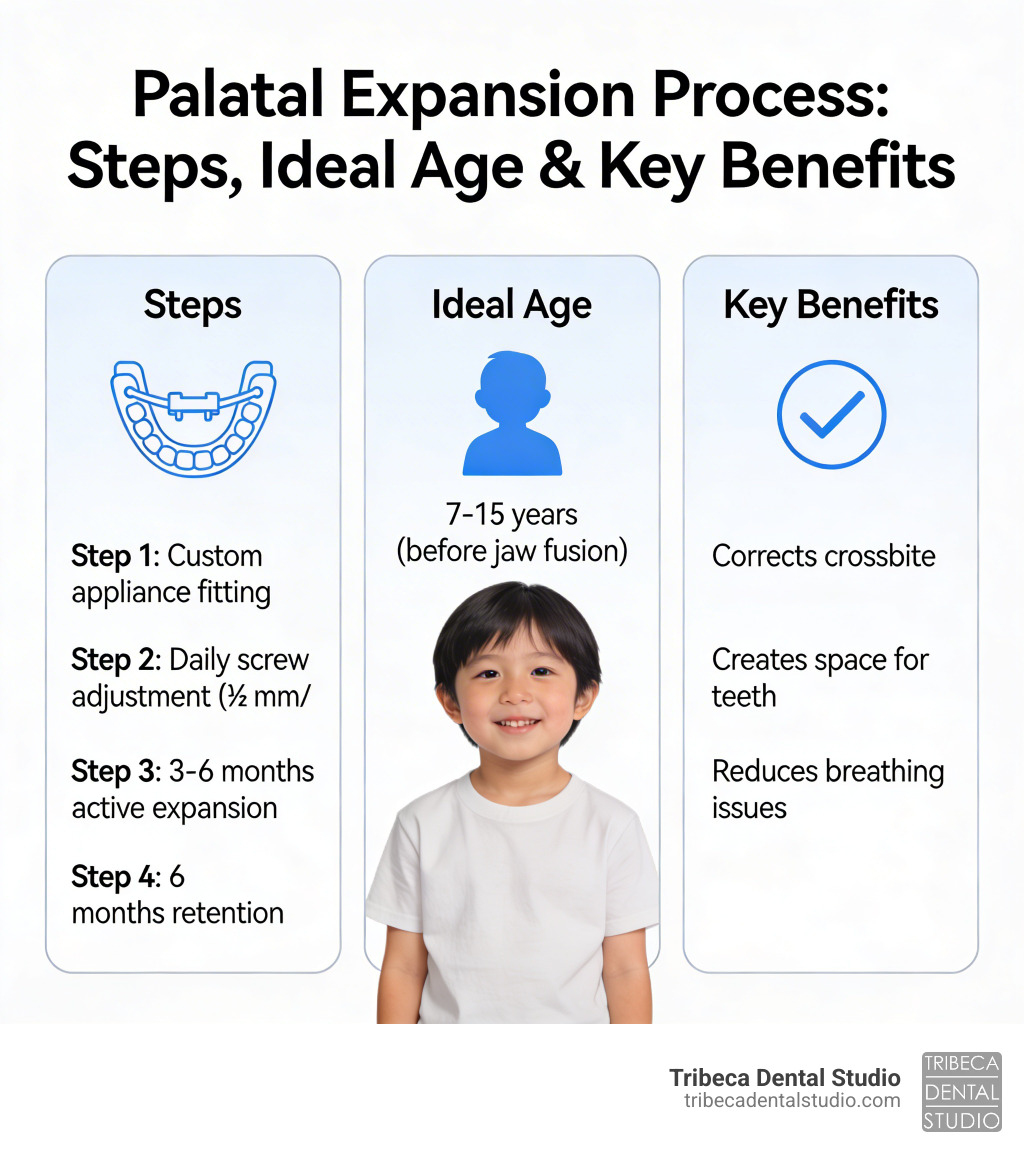
An orthodontic palate expander is a custom-fitted dental appliance that widens the upper jaw by gently separating its two halves along a natural midline joint called the midpalatal suture. Here’s a quick overview:
- What it does: Widens the upper jaw (maxilla) to correct bite problems and create space for teeth
- Who it’s for: Most effective in children ages 7-15, before the jawbones fully fuse
- How it works: A small screw is turned daily with a key, expanding the palate approximately ¼ mm per turn
- How long it takes: Active expansion typically lasts 3-6 months, followed by a retention phase of up to 6 months
- Common reasons to use one: Crossbite, crowded teeth, impacted canines, and even breathing difficulties
If your child’s dentist has mentioned a “narrow palate,” or if you’ve noticed crowded teeth, a misaligned bite, or mouth breathing, a palate expander may be exactly what’s needed — and it’s far less complicated than it sounds.
The upper jaw isn’t one solid bone. It’s actually two separate halves connected by a flexible joint. Before puberty, that joint is still soft and pliable, which makes it the ideal window for gentle, non-surgical expansion. After that window closes, treatment becomes more complex.
I’m Dr. Nina Izhaky, a graduate of NYU College of Dentistry and the founder of Tribeca Dental Studio, where I work alongside on-site specialists — including orthodontic experts — to provide personalized care that includes orthodontic palate expander treatment for both children and adults. Read on for everything you need to know, from how the appliance works to how to care for it at home.
Orthodontic palate expander further reading:
What is an Orthodontic Palate Expander and How Does It Work?
At its core, an orthodontic palate expander is a device designed to widen the maxilla (your upper jaw). While that might sound like a major structural change, it is actually a very common and predictable palatal expansion procedure in orthodontics.
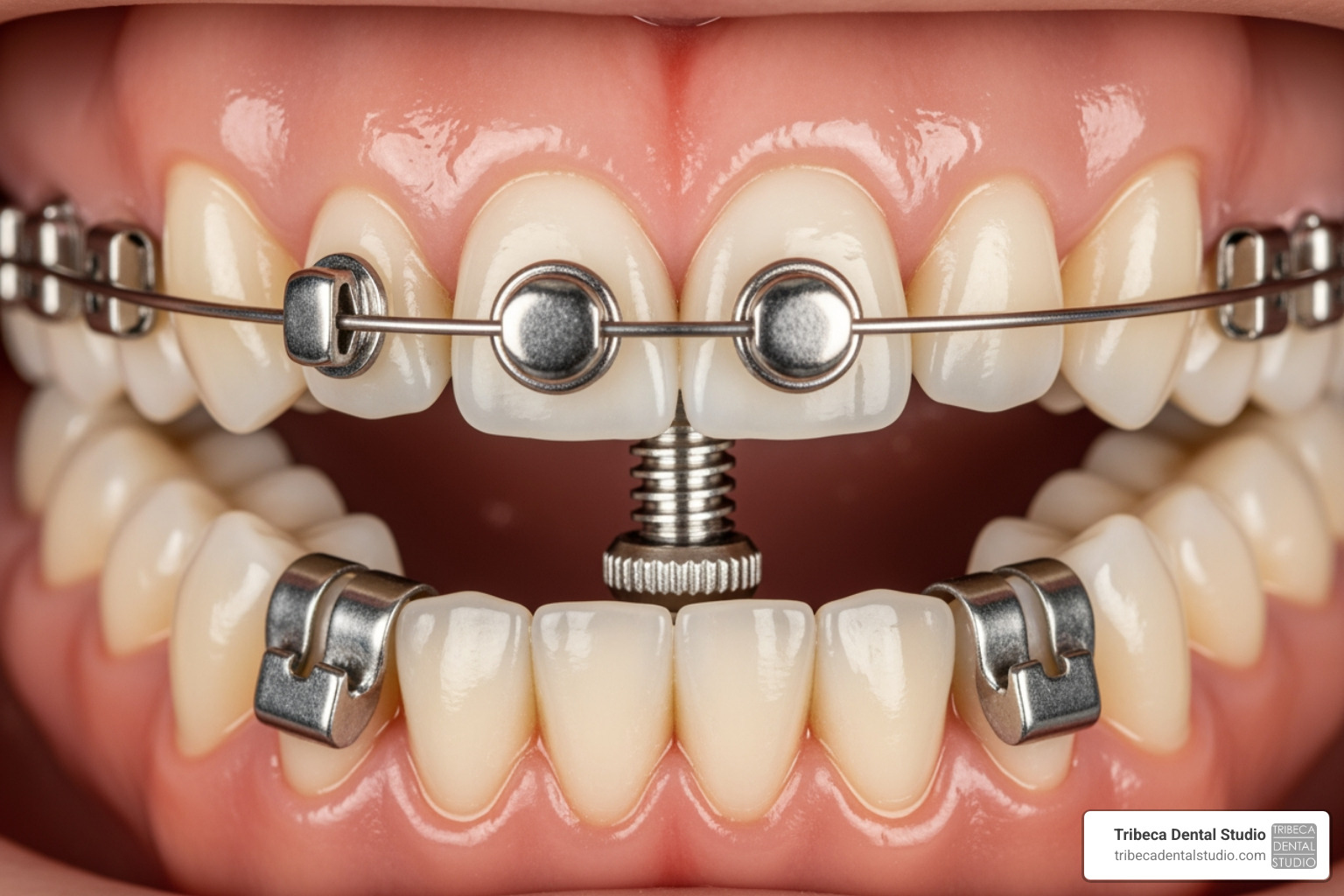
The appliance is custom-made to fit the unique shape of your mouth. It typically consists of two metal halves connected by a central expansion screw. These halves are anchored to the upper back molars. The “magic” happens at the midpalatal suture—the flexible line where the two bones of the upper palate meet. In children and young teens, this suture hasn’t yet fused into solid bone, acting much like a growth seam that we can gently nudge apart.
By widening the jaw, we aren’t just moving teeth; we are actually changing the skeletal structure to create a healthier foundation for the entire smile.
The Mechanics of Jaw Widening
How does a small metal device move bone? It’s all about consistent, gentle pressure. When we or a parent activate the expansion screw using a special key, the appliance gradually moves the two halves of the jaw apart.
Here are the numbers behind the movement:
- Each turn of the key expands the appliance by approximately 0.25 mm (1/4 mm).
- Rapid expansion can widen the jaw at a rate of up to 0.5 mm to 1.0 mm per day.
- As the bones separate, the body naturally fills in the tiny gap with new bone cells, solidifying the new, wider position.
Benefits Beyond Straight Teeth
While many people seek an orthodontic palate expander to fix a “crooked” smile, the benefits go much deeper—literally into the airway. Because the roof of your mouth is also the floor of your nasal cavity, widening the palate can improve breathing and airflow significantly.
By opening up the nasal passages, palatal expansion can be a life-changing treatment for children suffering from obstructive sleep apnea or chronic mouth breathing. It encourages proper tongue posture and better oxygen intake, which is why it’s a cornerstone of airway orthodontics.
Who Needs Palatal Expansion and What Does It Treat?
We often recommend an orthodontic palate expander when there is a clear “maxillary deficiency”—meaning the upper jaw is too narrow compared to the lower jaw. If left untreated, these issues caused by malocclusion can lead to long-term jaw pain, uneven tooth wear, and even facial asymmetry.
The most common conditions we treat with expansion include:
- Posterior Crossbite: This occurs when the upper back teeth bite inside the lower teeth.
- Severe Crowding: When the jaw is too narrow, there simply isn’t enough room for permanent teeth to erupt in a straight line.
- Impacted Canines: Expansion can create the necessary space for “stuck” teeth to emerge naturally, often helping patients avoid the need for surgical exposure or extractions.
Correcting Bite and Space Issues
A standard indicator for expansion is a difference in jaw width of 4 mm or more between the upper and lower arches. When we achieve correctly spaced teeth%20can%20be%20used.), it’s not just about aesthetics; it makes brushing and flossing much easier, reducing the risk of cavities and gum disease later in life.
At Tribeca Dental Studio, we view palatal expansion for children as a “preventive powerhouse.” By creating space early, we can often avoid the need to pull healthy permanent teeth later on.
The Ideal Age for Treatment
Timing is everything in orthodontics. We generally recommend an initial evaluation by age 7. At this stage, the midpalatal suture is still soft and pliable, allowing for maximum skeletal change with minimal discomfort.
As a child moves through puberty, the jawbones begin to fuse. While expansion is still very successful in the “mixed dentition” stage (when a child has both baby and adult teeth), it becomes more challenging once growth is complete. Starting early leverages the child’s natural growth spurt to achieve the best results.
Types of Expanders and Adult Alternatives
Not every mouth requires the same approach. Depending on the severity of the narrowing and the age of the patient, we choose from several different types of appliances.
| Expander Type | Best For | Key Feature |
|---|---|---|
| Rapid Palatal Expander (RPE) | Children/Teens | Fixed appliance; fast results (0.5mm/day) |
| Quad Helix | Mild Crowding | No key required; adjusted by the orthodontist |
| Removable Expander | Very Minor Issues | Can be taken out, but requires high compliance |
| MARPE | Young Adults | Uses mini-implants to expand fused bones |
| SARPE | Adults | Requires surgical assistance for bone separation |
Choosing the Right Orthodontic Palate Expander for Your Needs
For most of our younger patients in Manhattan, a fixed appliance like the Hyrax or Haas expander is the gold standard. These are “glued” to the teeth, which means we don’t have to worry about a child losing them or forgetting to wear them.
For young adults who may have missed the early growth window, we utilize MARPE techniques. MARPE (Miniscrew-Assisted Rapid Palatal Expansion) uses tiny temporary implants to apply pressure directly to the bone, rather than just the teeth.
Options for Adults and Mature Jaws
Can adults use an orthodontic palate expander? The answer is yes, but the method changes. Since adult sutures are fully fused, a standard expander might only tip the teeth outward without widening the underlying bone.
In these cases, we may recommend Surgically Assisted Rapid Palatal Expansion (SARPE) or other adult expansion techniques. These procedures involve a collaboration between our orthodontists and an oral surgeon to “release” the fused suture, allowing the expander to do its work effectively even in a mature jaw.
How to Adjust and Care for Your Orthodontic Palate Expander
One of the most common concerns parents have is: “Will it hurt?” While you will feel pressure—often described as a tingling sensation at the bridge of the nose or under the eyes—it is rarely described as painful. Most patients adjust to the feeling within a few minutes of a turn.
You might also notice some temporary speech distortion or extra saliva in the first few days. We usually suggest reading out loud or singing in the shower to help the tongue get used to the new appliance!
How to Activate Your Orthodontic Palate Expander at Home
If we’ve prescribed a “turn” schedule, you’ll be doing the adjustments at home. It’s easier than it looks! Here is our step-by-step guide:
- Find a well-lit area: Have the patient tilt their head back (laying on a bed or sofa works great).
- Insert the key: Place the metal key firmly into the hole in the center of the expander.
- Push toward the throat: Rotate the key toward the back of the mouth in one smooth motion until it stops and a new hole appears at the front.
- Remove carefully: Press the key back and down toward the tongue to slide it out without undoing the turn.
- Track your progress: Use a chart to mark off each turn so you stay on schedule for your next visit to our Tribeca office.
Maintenance, Diet, and Hygiene
Keeping the expander clean is vital for healthy gums. Because the appliance sits against the roof of the mouth, food can easily get trapped.
- Brushing: Brush the appliance every time you brush your teeth.
- Water Flossers: These are fantastic for flushing out debris from behind the metal bars.
- Dietary Adjustments: Avoid sticky, chewy, or hard foods. Think: no gum, taffy, caramels, or popcorn. These can loosen the bands or get stuck in the screw mechanism.
- Emergency Care: If the expander feels loose or a band breaks, give us a call immediately. This is considered an orthodontic emergency because the jaw can begin to “relapse” or shift back quickly if the appliance isn’t secure.
Frequently Asked Questions
How long does palatal expander treatment last?
The active “turning” phase is surprisingly short—usually only 3 to 6 months. However, once the desired width is reached, the expander must stay in place for another 6 to 12 months. This “retention” phase is critical; it gives the new bone time to harden and stabilize. If we removed it too early, the jaw would likely narrow again. You can learn more about how this fits into a broader plan on our airway orthodontics services page.
Does palatal expansion work on the lower jaw?
Technically, no. The lower jaw (mandible) does not have a midline suture like the upper jaw. While we can use “expanders” on the lower teeth, they mostly work by uprighting or tipping the teeth into a wider position rather than expanding the actual bone.
Is the gap between front teeth normal?
Yes! In fact, it’s a sign that the treatment is working perfectly. This gap (called a diastema) shows that the two halves of the jawbone are actually separating. Don’t worry—the gap is temporary. Once the expansion is finished, the teeth usually shift back toward the center on their own, and any remaining space is closed later with braces or Invisalign.
Conclusion
At Tribeca Dental Studio, we believe that a healthy smile starts with a strong foundation. Whether you are looking for early intervention for your child or exploring adult expansion options in New York City, our team led by Dr. Nina Izhaky is here to guide you through every turn. We pride ourselves on a personalized approach that makes high-tech orthodontic care feel like a visit with family.
If you’re ready to see how an orthodontic palate expander can transform your bite and your breathing, schedule an Airway Orthodontics consultation with us today in the heart of Tribeca. We look forward to helping you breathe easier and smile wider!