Why Finding the Right TMJ Specialist in NYC Can Change Your Life
If you’re looking for a TMJ specialist NYC, here’s what you need to know right away:
Quick Answer: How to Find a TMJ Specialist in NYC
- Look for a board-certified Orofacial Pain specialist (Diplomate of the American Board of Orofacial Pain)
- Search the American Board of Orofacial Pain directory for verified specialists
- Choose a provider who offers a personalized, multidisciplinary approach — not a one-size-fits-all solution
- Expect a thorough first exam: medical history, muscle palpation, jaw evaluation, and imaging if needed
- Treatment options range from custom oral appliances and Botox to physical therapy and, in rare cases, surgery
Jaw pain is easy to brush off. A little clicking here, a tension headache there — it’s tempting to just push through it.
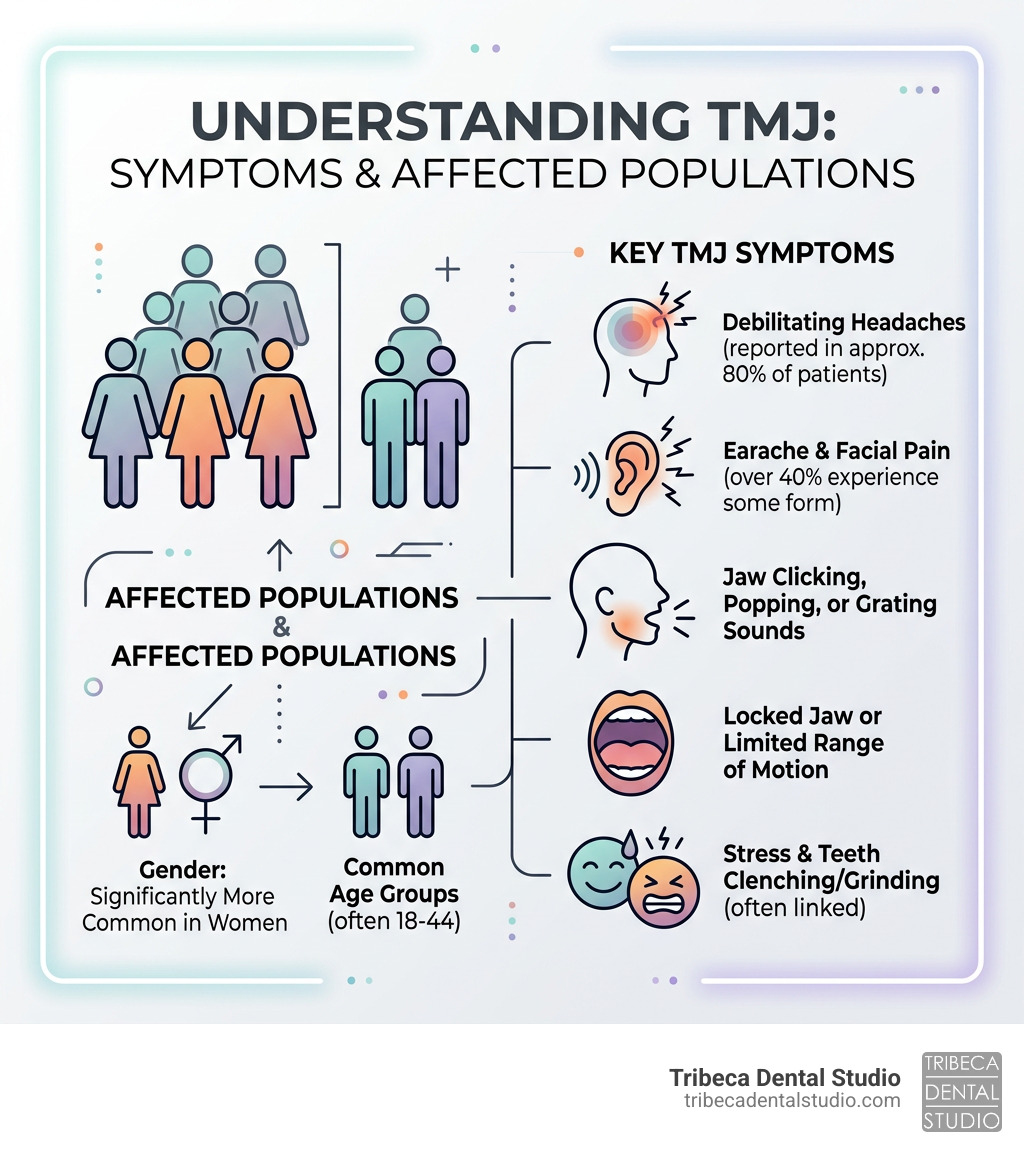
But for millions of people, TMJ disorders are far more than a minor annoyance. Around 80% of patients with a TMJ disorder report debilitating headaches, and over 40% experience some form of facial pain. Women are disproportionately affected, making up roughly 80% of TMJ patients.
In a city as as New York, finding the right specialist — one who actually understands the complexity of jaw pain — can feel overwhelming. Not every dentist or doctor is trained to diagnose and treat TMJ disorders accurately. And the wrong treatment can make things worse.
That’s exactly why this guide exists.
I’m Dr. Nina Izhaky, a graduate of New York University College of Dentistry and the founder of Tribeca Dental Studio, where I’ve helped countless New York patients get real relief from jaw pain through personalized, evidence-based care — making me well-positioned to help you navigate the search for a TMJ specialist NYC. Whether you’re just starting to notice symptoms or you’ve already seen multiple providers without relief, the information ahead will help you make a confident, informed decision.
TMJ specialist NYC definitions:
Understanding TMJ Disorders: Symptoms, Causes, and Risk Factors
To find the right TMJ specialist NYC, we first need to understand what we are dealing with. “TMJ” refers to the temporomandibular joint itself—the ball-and-socket hinge that connects your lower jaw (mandible) to your skull (temporal bone). When things go wrong with the joint, the muscles, or the disc that cushions the movement, we call it TMD (Temporomandibular Disorder).
Common Symptoms
The symptoms of TMD are often sneaky. You might not even realize your earache or dizziness is actually a jaw issue. Common signs include:
- Myofascial Pain: Deep, dull aching in the jaw muscles (masseter and temporalis).
- Jaw Clicking or Popping: Sounds that occur when opening or closing your mouth.
- Lockjaw: The jaw getting stuck in an open or closed position.
- Bruxism: Chronic teeth grinding or clenching, often worst at night.
- Ear Issues: Feeling “underwater,” tinnitus (ringing), or vertigo without an ear infection.
Why Does It Hurt?
There isn’t just one cause for TMJ pain. It is often a “perfect storm” of factors. One major question patients ask is why does it hurt when I chew?. This is usually due to the muscles being overworked or the disc being out of place.
Research shows that 80% of TMJ patients are women, which may be linked to estrogen receptors in the jaw joint that increase susceptibility to pain and joint laxity. Other risk factors include:
- Trauma: A direct blow to the face or whiplash from a car accident.
- Malocclusion: An uneven bite that forces the muscles to work harder to find a resting position.
- Post-Surgical Issues: Some patients notice TMJ disorder after wisdom teeth removal due to the jaw being held open for an extended period.
- Systemic Conditions: Arthritis or autoimmune diseases that attack the joints.
Finding a Qualified TMJ Specialist NYC
In a city with thousands of dentists, how do you pick the right one? The “gold standard” for jaw pain is a board-certified Orofacial Pain specialist. This is a recognized dental specialty that focuses on diagnosing and treating pain in the jaw, mouth, face, head, and neck.
When searching for a TMJ specialist NYC, look for these credentials:
- Board Certification: Specifically through the American Board of Orofacial Pain (ABOP).
- Clinical Experience: How many years have they focused on TMJ? Some providers have been doing this for decades, even before it was an official specialty.
- Multidisciplinary Approach: Do they work with physical therapists, neurologists, and sleep specialists? TMJ is rarely “just” a tooth problem.
Why You Need a Board-Certified TMJ Specialist NYC
An ABOP diplomate has passed rigorous exams and completed extensive postgraduate training. This matters because many general dentists might suggest “grinding down your teeth” to fix your bite. However, modern scientific literature has largely debunked the “bite correction” myth for TMJ relief. A true specialist knows that how to stop grinding your teeth at night involves neurological and muscular retraining, not necessarily irreversible dental work.
Navigating Treatment with a TMJ Specialist NYC
Your journey should always start with a conservative approach. A top-tier specialist will prioritize evidence-based protocols. This includes a patient-centered history (asking about your stress levels and sleep quality), a cranial nerve screening to rule out other neurological issues, and a detailed muscle palpation to find trigger points.
Advanced Treatment Options for Jaw Pain Relief
The “less is more” rule of thumb is vital in TMJ therapy. Most patients do not need surgery. In fact, conservative management is successful for the vast majority of cases.
| Treatment | How It Works | Best For |
|---|---|---|
| Oral Appliances | Custom-fit guards that reposition the jaw or prevent clenching. | Bruxism, disc displacement, morning headaches. |
| TMJ Botox | Injections that temporarily relax the masseter and temporalis muscles. | Severe muscle spasms, facial slimming, chronic clenching. |
| Physical Therapy | Targeted exercises, ultrasound, and manual release. | Limited range of motion, posture-related jaw pain. |
| Trigger Point Injections | Localized injections of anesthetic or saline into “knots.” | Myofascial pain and localized muscle tension. |
Custom Night Guards vs. Over-the-Counter
While you can buy a “boil-and-bite” guard at a drugstore, these often make TMJ worse by providing a “chewy” surface that encourages more clenching. A TMJ specialist NYC will provide a custom-fit appliance, such as an NTI device, which is designed to keep the back teeth from touching, shutting down the clenching reflex. If you are looking for how to stop grinding teeth naturally, custom appliances combined with stress management are the most effective path.
Advanced Surgical Interventions
For a small percentage of patients (roughly 5-10%), conservative therapy isn’t enough. In these cases, a clinical overview of TMJ and facial pain might suggest minimally invasive procedures like:
- Arthrocentesis: Flushing the joint with fluid to remove inflammatory byproducts.
- Arthroscopy: Using a tiny camera and tools to remove scar tissue or reposition the disc.
- Total Joint Replacement: Reserved for severe degenerative changes or bone-on-bone arthritis.
Innovative Therapies from a TMJ Specialist NYC
Modern NYC clinics now use 3D imaging and CBCT scans to see the joint in three dimensions. This allows us to check for bone erosion or “condylar resorption” (common in adolescent girls due to estrogen shifts). Additionally, we often perform an airway evaluation, as many people clench their jaw at night as a subconscious effort to keep their airway open during sleep.
At-Home Remedies and Self-Care for Immediate Relief
While you wait for your appointment with a TMJ specialist NYC, you can take steps to lower your pain levels today.
- The Soft Food Diet: Give your muscles a “vacation.” Avoid steak, bagels, gum, and crunchy carrots. Think smoothies, mashed potatoes, and yogurt.
- Warm Compress Therapy: Apply moist heat to the sides of your face for 15 minutes several times a day to increase blood flow and relax the masseter muscles.
- Jaw Stretching: Practice gentle, controlled opening. A good rule of thumb is to keep your “lips together, teeth apart.”
- Stress Management: Since there is a strong link between anxiety and teeth grinding, practices like meditation or biofeedback can physically lower the tension in your jaw.
- Sleep Posture: Try to sleep on your back. Sleeping on your stomach or side can put uneven pressure on the jaw joints.
If you are struggling with how to stop grinding teeth, these self-care tips are a great starting point, but they should be used in conjunction with professional care.
Cost, Insurance, and What to Expect at Your First Visit
One of the biggest hurdles for patients is the cost of a TMJ specialist NYC. Because TMJ is a medical condition that manifests in the mouth, insurance can be tricky.
Insurance and Diagnostic Codes
Many TMJ treatments can be billed to medical insurance rather than dental insurance. This is because TMD is classified as a musculoskeletal disorder, similar to a knee or back injury. A qualified office will help you navigate diagnostic codes for “facial pain” or “arthralgia of the TMJ” to maximize your benefits.
Your First Consultation
What happens when you walk through our doors?
- Clinical Examination: We check your range of motion (normal opening is 36-54 mm).
- Muscle Palpation: We gently press on the jaw, neck, and temple muscles to identify “referred pain.”
- Joint Evaluation: We listen for clicking, popping, or “crepitus” (a gravel-like sound).
- Discussion of Timelines: Most patients feel significant relief within 6-8 weeks of starting appliance therapy, though chronic cases may take longer.
Long-Term Prognosis
The goal of a TMJ specialist NYC isn’t just to stop the pain today—it’s to prevent permanent joint damage. With the right intervention, the prognosis is excellent. Most patients return to a normal diet and a pain-free life without ever needing surgery.
Frequently Asked Questions about TMJ
What is the difference between TMJ and TMD?
TMJ is the name of the joint (Temporomandibular Joint). TMD is the disorder or condition (Temporomandibular Disorder). Think of it like “knee” versus “knee arthritis.” People often use the terms interchangeably, but a TMJ specialist NYC will usually refer to the condition as TMD.
Does medical insurance cover TMJ treatment in New York?
Yes, in many cases. Because it is a joint and muscle condition, many New York medical plans cover the initial consultation, imaging (like CT scans), and even some appliances or Botox injections if they are deemed “medically necessary” for pain management.
Can TMJ cause ear pain and tinnitus?
Absolutely. The TMJ is located right next to the ear canal. There is even a small ligament (Pinto’s ligament) that connects the jaw joint to the tiny bones in the middle ear. Inflammation in the jaw can easily lead to earaches, dizziness, or a ringing sound (tinnitus).
Conclusion
Living with jaw pain is exhausting. It affects how you eat, how you speak, and even how you interact with the world. But you don’t have to “grin and bear it.” At Tribeca Dental Studio, we believe that everyone deserves a life free from debilitating facial pain and headaches.
Under the leadership of Dr. Nina Izhaky, we provide a welcoming, family-like atmosphere where we treat the person, not just the symptoms. We combine advanced technology like 3D imaging with a personalized, conservative approach to ensure you get the relief you need without unnecessary procedures.
If you’re ready to reclaim your quality of life, book your NYC TMJ consultation today at our Tribeca office. Let’s work together to find a solution that lasts.