When Half a Tooth Breaks Off: What You Need to Know First
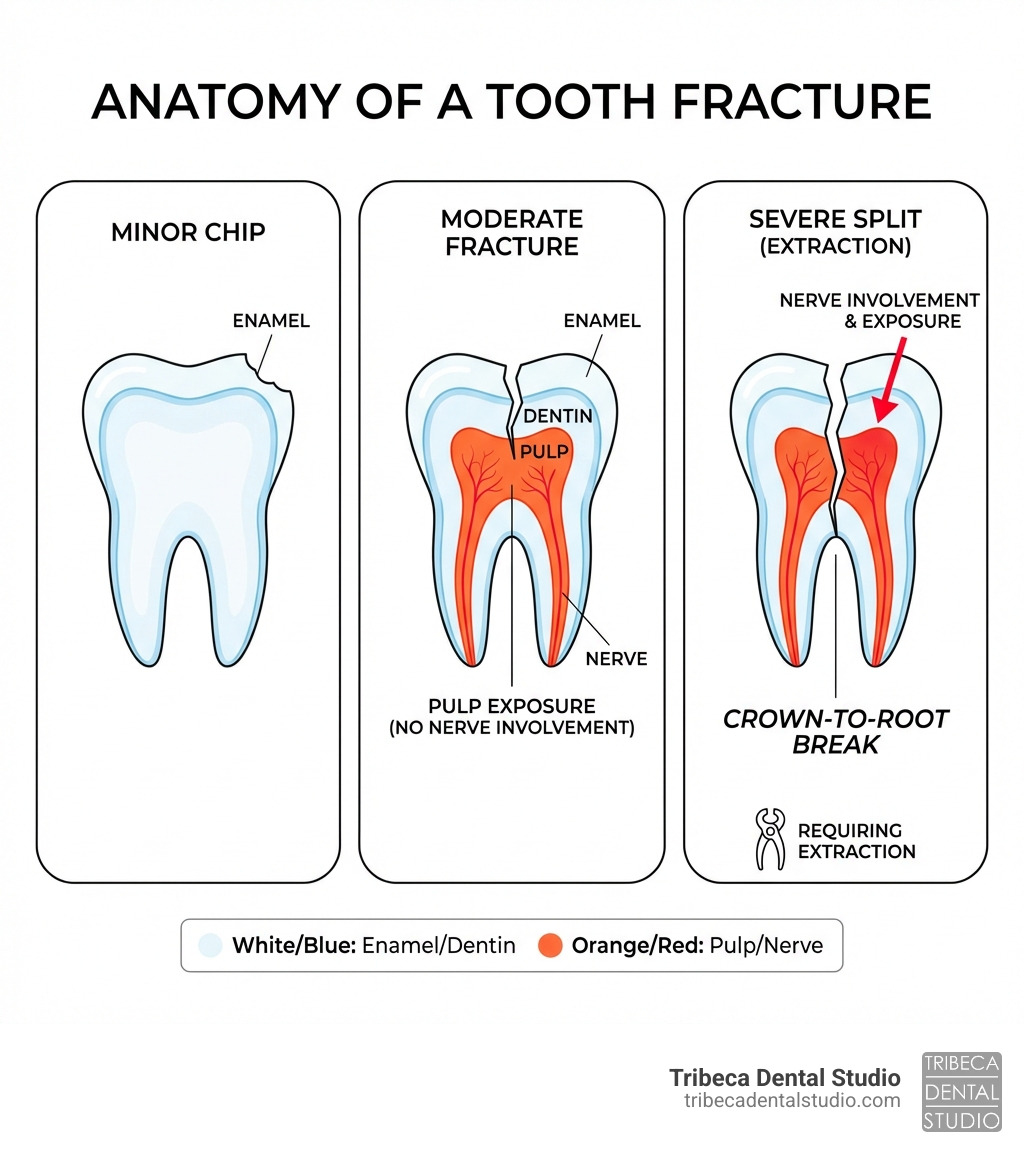
A half broken tooth is more than just a painful inconvenience — it’s a dental situation that needs attention fast. Here’s a quick look at your repair options based on how severe the break is:
| Severity | Typical Treatment |
|---|---|
| Minor chip or crack | Dental bonding or composite filling |
| Moderate break (no nerve involved) | Dental crown |
| Break reaching the pulp/nerve | Root canal + dental crown |
| Fracture below the gumline | Extraction + implant or bridge |
The good news? Most half-broken teeth can be saved — especially when you act quickly.
That sharp, jarring moment when you feel a tooth give way — whether you were biting into something hard or took an unexpected hit — is unsettling. Beyond the immediate pain, a broken tooth exposes the soft inner layers of your tooth to bacteria, temperature, and pressure. Left untreated, even a small fracture can escalate into an infection, an abscess, or permanent tooth loss.
This guide walks you through exactly what to do, from the moment your tooth breaks to the full range of repair options available to you.
I’m Nina Izhaky, a graduate of New York University College of Dentistry and the founder of Tribeca Dental Studio, where I’ve helped countless patients restore half broken teeth using the latest restorative techniques. I’ll help you understand your options clearly so you can make the best decision for your smile.
Half broken tooth terms to learn:
Common Causes and Symptoms of a Half Broken Tooth
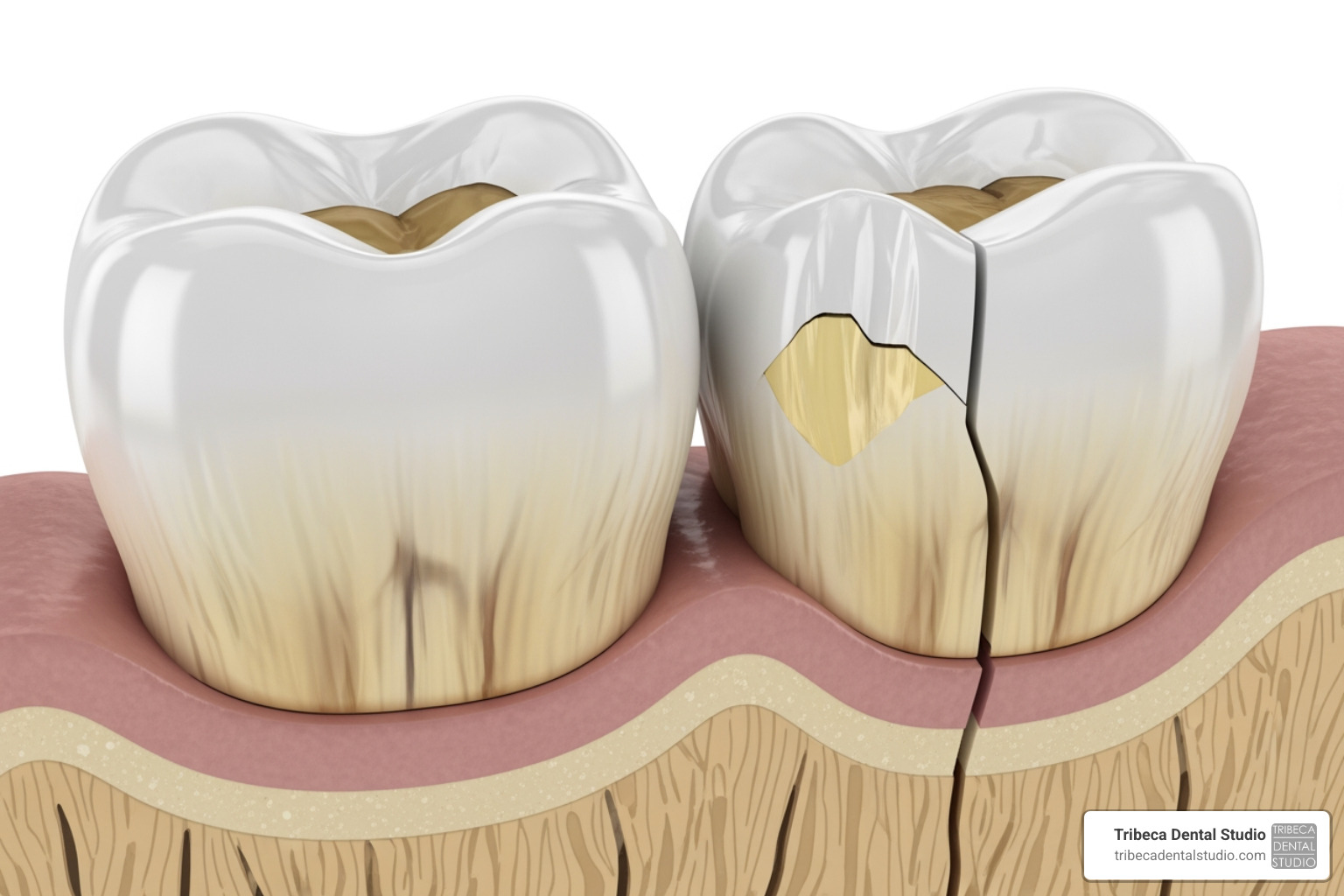
Understanding why a tooth breaks is the first step in preventing it from happening again. While our enamel is the hardest substance in the human body, it isn’t invincible. Think of it like a sturdy porcelain plate—it can handle a lot of pressure, but the right impact at the wrong angle can cause it to shatter.
Why Do Teeth Break in Half?
There are several reasons we see patients coming into our Tribeca office with a half broken tooth:
- Untreated Decay: This is the most common culprit. Cavities act like termites in a house; they eat away at the internal structure of the tooth, leaving a hollow shell that eventually collapses under the pressure of normal chewing.
- Bruxism (Teeth Grinding): Many New Yorkers carry their stress in their jaws. Constant grinding and clenching put immense pressure on your molars, leading to “fatigue fractures” over time.
- Sports Injuries and Trauma: Accidents happen. Whether it’s a fall on the pavement or a stray elbow during a basketball game, physical impact is a major factor. In fact, over 5 million teeth are lost or fractured annually due to accidents and sports-related injuries.
- Biting Hard Objects: We’ve all done it—tried to crunch a piece of ice, a popcorn kernel, or a hard candy. Sometimes the tooth wins; sometimes the candy does.
- Large, Old Fillings: If you have an old silver (amalgam) filling that takes up most of the tooth, the remaining natural tooth structure is thin and prone to snapping off.
Symptoms You Shouldn’t Ignore
How do you know if your break is serious? Sometimes it’s obvious—you literally have half a tooth in your hand. But other times, the fracture is internal. Watch out for:
- Temperature Sensitivity: Sharp pain when drinking hot coffee or cold water. This usually means the dentin (the layer under the enamel) or the pulp (the nerve) is exposed.
- Intermittent Chewing Pain: It doesn’t hurt all the time, but when you bite down or release your bite, you feel a “zap.”
- Sharp Edges: Your tongue keeps finding a rough or jagged spot that wasn’t there before.
- Facial Swelling: If the gum around the tooth starts to puff up, it’s a sign that bacteria have entered the break and an infection is brewing.
Immediate First Aid: What to Do Right Away
If you’ve just experienced a tooth break, don’t panic. What you do in the first hour can significantly impact whether we can save the tooth.
Step 1: Rinse and Assess
Gently rinse your mouth with warm salt water. This helps clear away debris and acts as a mild disinfectant to keep bacteria at bay. If there is bleeding, apply light pressure with a piece of clean gauze for about 10 minutes or until it stops.
Step 2: Save the Fragment
If you can find the piece of the tooth that broke off, pick it up by the “crown” (the part you usually see) and never the root. Rinse it gently with water—don’t scrub it! Store it in a small container of milk or even your own saliva. In some cases, we can actually bond the original piece back onto the tooth.
Step 3: Protect Your Mouth
A half broken tooth often has razor-sharp edges that can slice your tongue or cheek. You can cover these edges with a small piece of dental wax or even sugar-free gum as a temporary shield until you get to our office.
Step 4: Manage the Pain
Over-the-counter pain relievers like ibuprofen or acetaminophen can help manage discomfort. You can also apply a cold compress to the outside of your cheek to keep swelling down.
| Home Relief Step | Why It Matters | Professional Emergency Care |
|---|---|---|
| Saltwater Rinse | Reduces bacteria and cleans the area. | Emergency dentistry services provide a permanent fix. |
| Dental Wax/Gum | Protects soft tissue from sharp edges. | The dentist smooths or restores the edge permanently. |
| Milk Preservation | Keeps the tooth fragment “alive” for possible reattachment. | The dentist uses professional bonding agents to secure the fragment. |
| OTC Meds | Temporarily numbs the pain. | Local anesthesia ensures a completely pain-free repair process. |
Professional Repair Options for a Half Broken Tooth
Once you arrive at Tribeca Dental Studio, our first goal is to assess the damage. We use digital X-rays to see if the fracture extends below the gumline or into the root. A break that stays above the gumline is usually much easier to fix. However, if you have a vertical root fracture (a crack that goes all the way down the root), the tooth may not be salvageable.
Restoring a Half Broken Tooth with Bonding
For minor chips or breaks where the nerve isn’t exposed, we often recommend dental bonding. This is one of the most conservative and cost-effective ways of fixing a fractured tooth.
We use a tooth-colored composite resin (the same material used for tooth-colored fillings) and sculpt it to match the natural shape of your tooth. We then “cure” it with a special light to harden it instantly. This is a fantastic option for front teeth where aesthetics are the priority.
Saving a Half Broken Tooth with Crowns or Root Canals
If the break is more substantial—say, half the molar has snapped off—a simple filling won’t be strong enough to handle the pressure of chewing.
- Dental Crowns: We often describe dental crowns as a “helmet” for your tooth. It covers the entire visible portion of the tooth, protecting it from further fractures and restoring its full strength.
- Root Canals: If the break reaches the pulp (the center of the tooth where the nerves and blood vessels live), you’ll likely need a root canal. Don’t worry—modern root canals are no more uncomfortable than getting a filling. We remove the damaged pulp, clean the canal, and seal it to prevent infection. Afterward, a crown is placed on top to keep the tooth functional.
Solutions for Severe Fractures and Extractions
Sometimes, a tooth breaks so severely—usually deep below the gumline or splitting the root in half—that it cannot be saved. In these cases, we prioritize your long-term oral health by performing a gentle extraction.
Leaving a non-restorable half broken tooth in your mouth is a recipe for chronic pain and systemic infection. Once the tooth is removed, we have excellent options for replacement:
- Dental Implants: These are the gold standard. A dental implant acts as a new root, preventing bone loss in your jaw and supporting a beautiful, custom-made porcelain tooth.
- Dental Bridges: If an implant isn’t right for you, a bridge uses the neighboring teeth as anchors to “bridge” the gap where the missing tooth was.
- Partial Dentures: For cases where multiple teeth are involved, a removable partial denture can restore your smile’s function.
Preventing Future Fractures and Complications
Once we’ve fixed your half broken tooth, we want to make sure you don’t end up back in the emergency chair! Prevention is much cheaper and less stressful than repair.
- Wear a Mouthguard: If you play sports (even weekend pick-up games), a mouthguard is essential. If you grind your teeth at night, a custom-fitted night guard is a lifesaver. It cushions the teeth and prevents the “fatigue” that leads to cracks.
- Address Occlusal Disease: Sometimes teeth break because your bite is “off.” If certain teeth are hitting harder than others, they will eventually fracture. We can evaluate your bite to ensure the pressure is distributed evenly.
- Ditch the Hard Habits: Stop chewing on ice, pens, or fingernails. And please, never use your teeth as tools to open packages!
- Regular Checkups: During your routine visits, we look for “craze lines” (tiny surface cracks) and signs of failing old fillings. Catching a weakness early means we can reinforce the tooth with a small filling or onlay before it breaks in half.
- Fluoride and Hygiene: Keeping your enamel strong through good hygiene and fluoride treatments makes it more resistant to the decay that weakens tooth structure. According to Cleveland Clinic’s guide to oral health, maintaining the integrity of your enamel is your first line of defense against all forms of dental trauma.
Frequently Asked Questions about Broken Teeth
Can a broken tooth piece be reattached?
Yes, it is possible! If the fragment is clean and intact, and you’ve kept it moist in milk or saliva, we can sometimes use high-strength bonding agents to reattach it. However, this is usually a better option for front teeth that don’t take the heavy load of chewing. For molars, a more durable restoration like a crown is often safer.
How much does it cost to fix a half-broken tooth?
The fractured tooth repair cost varies significantly based on the treatment needed. A simple bonding might cost a few hundred dollars, while a root canal and crown can range from $2,000 to $4,000 depending on the complexity.
In New York City, rates can be higher due to the specialized care available, but most dental insurance plans cover a significant portion of restorative work (usually 50% to 80% for crowns and root canals). We always provide a clear breakdown of costs before starting any treatment.
Is a broken tooth always a dental emergency?
If you are in pain, have swelling, or the break has left a sharp edge, yes—it is an emergency. Even if it doesn’t hurt, you should still see us within 24 hours. A broken tooth is a dental emergency because the protective enamel is gone, leaving the interior of your tooth wide open to infection. The longer you wait, the higher the risk that a simple repair turns into a complex root canal or extraction.
Conclusion
A half broken tooth can feel like a disaster, but with modern dentistry, it’s a problem we solve every single day. Whether you need a simple aesthetic touch-up or a full structural restoration, our team at Tribeca Dental Studio is here to help you move from “half-broken” back to “whole.”
Under the leadership of Dr. Nina Izhaky, we take a personalized, family-style approach to every patient. We understand that dental emergencies are stressful, and we strive to make your repair process as comfortable and transparent as possible.
If you’re dealing with a chip, crack, or a tooth that has snapped in half, don’t wait for the pain to get worse. Explore our cosmetic dentistry options to repair a chipped tooth and schedule a consultation with us today. We’ll get your smile back on track in no time!