What Full Arch Implants Actually Are (And Why They Matter)
Full arch implants are a permanent, fixed solution for replacing an entire row of missing or failing teeth — upper, lower, or both — using just four to six titanium posts anchored into the jawbone.
Here’s a quick snapshot of what you need to know:
- What they are: A full bridge of prosthetic teeth (typically 10–14 teeth) supported by 4–6 implants per jaw
- Who they’re for: Adults missing most or all teeth in one or both jaws, or those with failing teeth that can’t be saved
- Key procedures: All-on-4, All-on-6, zygomatic implants, pterygoid implants
- How long they last: Titanium implants can last a lifetime; the prosthetic bridge typically lasts 10–20+ years
- Survival rates: 92%–99% over 5–10 years for All-on-4 and All-on-6 systems
- Same-day teeth: In many cases, a temporary arch is placed the same day as surgery
Tooth loss does more than change how you look. It affects how you eat, how you speak, and — quietly, over time — how much of your jawbone remains. Without tooth roots to stimulate the bone, the jaw begins to shrink. That changes your facial shape. It can make you look older than you are. And it makes future dental treatment more complicated.
Full arch implants stop that process. They replace both the visible teeth and the root function that keeps the jawbone healthy.
I’m Dr. Nina Izhaky, founder of Tribeca Dental Studio and a graduate of NYU College of Dentistry with experience in restorative and implant dentistry, including full arch implants for patients who need comprehensive smile rehabilitation. At Tribeca Dental Studio, our highly experienced team — including implant specialist Dr. Sam Morhaim — is committed to delivering predictable outcomes using advanced digital workflows and the latest implant techniques.
Quick full arch implants definitions:
What Are Full Arch Implants?
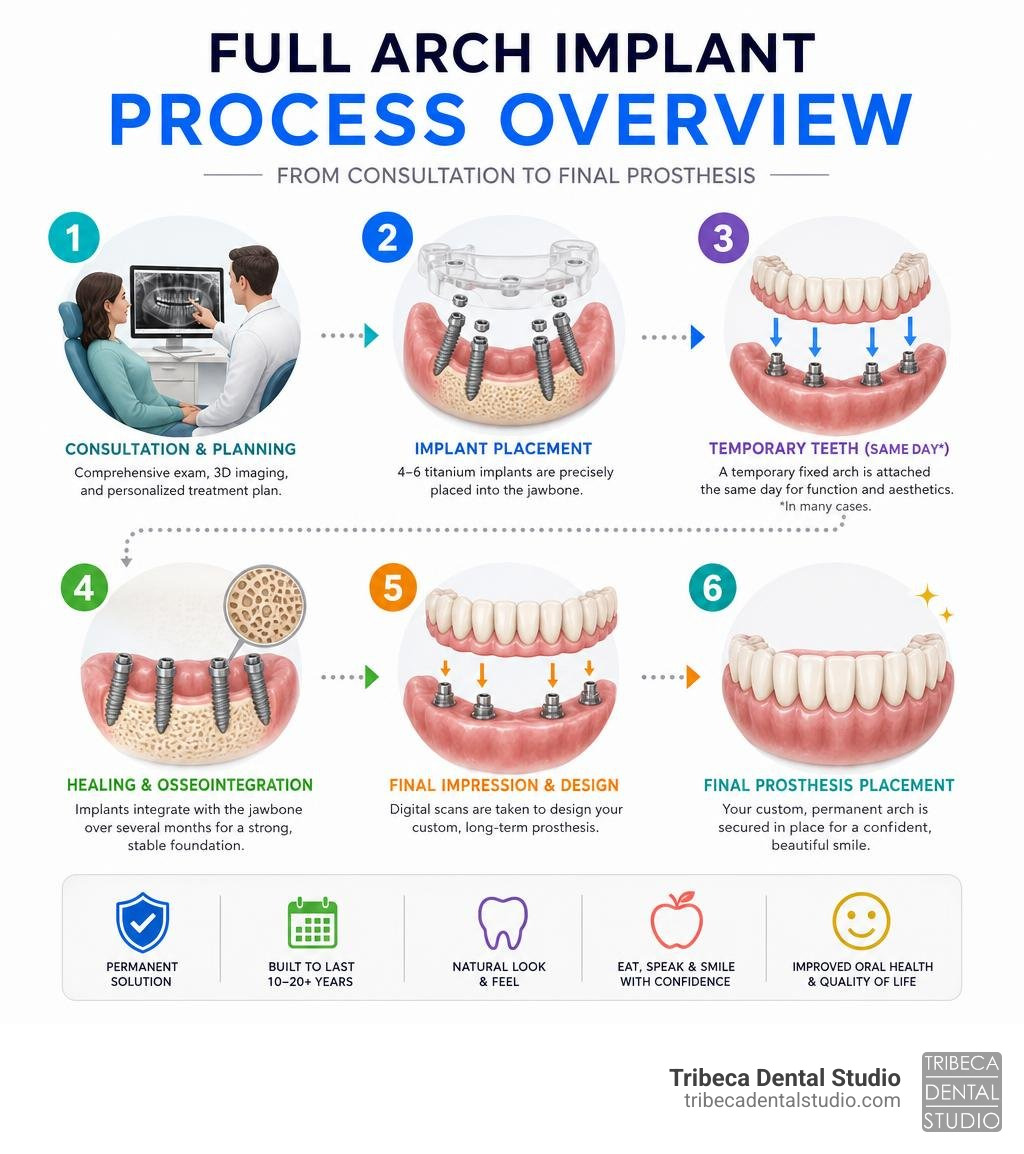
To truly understand what full arch implants are, it helps to look at them as the ultimate marriage of biology and engineering. Unlike a single-tooth implant, which replaces one root and one crown at a time, a full arch restoration replaces an entire row of teeth (an “arch”) using a strategic, minimal number of medical-grade titanium posts.
These posts are surgically inserted into the jawbone, where they undergo osseointegration — a natural process where the bone fuses directly to the titanium. Once healed, these posts serve as a rock-solid anchor for a custom-milled prosthetic bridge.
For patients dealing with widespread tooth loss or severe dental decay, trying to replace every single tooth with an individual implant is incredibly inefficient and biologically taxing. Instead, full arch restorations simplify the process, restoring complete function and aesthetics using as few as four to six implants per jaw.
Beyond restoring your ability to chew and speak normally, the primary health benefit of this procedure is jawbone preservation. When you lose teeth, the surrounding bone no longer receives the chewing forces that signal it to rebuild itself. This leads to bone resorption (atrophy), which eventually causes the lower face to sag and collapse. By mimicking natural tooth roots, dental implants stimulate the bone, preserving your natural facial structure and youthful contouring.
Our philosophy at Tribeca Dental Studio is rooted in conservative smile design. Before we ever recommend extracting teeth for a full arch restoration, we thoroughly evaluate whether we can save your natural teeth. As a leading practice known for excelling in no-prep veneers in NYC, we prioritize preserving as much natural tooth structure as possible. Through advanced cosmetic techniques like no-prep veneers, custom dental crowns, and dedicated gum disease treatment (including deep cleaning and expert periodontal care), we can often rebuild a damaged smile without resorting to extractions. However, when teeth are truly failing or already missing, our comprehensive dental implant services provide the most stable, life-changing alternative available.
Comparing Full Arch Implants to Traditional Dentures
If you have ever worn traditional removable dentures, or watched a loved one struggle with them, you already know their limitations. Traditional dentures rest directly on top of the gums, relying on suction or messy adhesives to stay in place. Because they have no physical connection to the jawbone, they are highly prone to slipping, clicking, and shifting while you eat or speak.
Furthermore, traditional dentures only restore about 30% of your natural bite function. This forces many people to abandon their favorite foods, shifting to a soft-food diet that lacks vital nutrients. Worse still, because traditional dentures do nothing to prevent bone loss, the jawbone continues to shrink over time. This constant bone loss changes the shape of your mouth, requiring frequent, uncomfortable denture relines and replacements every 7 to 15 years.
In contrast, fixed full arch implants are secured directly into the bone, restoring up to 90% or more of your natural chewing power. They do not slip, do not require adhesives, and are brushed and flossed just like natural teeth.
| Feature | Fixed Full Arch Implants | Traditional Removable Dentures |
|---|---|---|
| Support Method | Anchored securely into the jawbone | Rests on top of the gums |
| Bite Function | Restores 90%+ chewing power | Restores ~30% chewing power |
| Bone Preservation | Actively stimulates and preserves jawbone | Accelerates bone loss due to constant friction |
| Stability | Fixed in place; no slipping or clicking | Prone to shifting, sliding, and falling out |
| Adhesives Needed | None | Yes, frequently required |
| Maintenance | Normal brushing and flossing | Must be removed nightly for soaking and cleaning |
| Lifespan | Implants can last a lifetime; bridge lasts 10–20+ years | Must be relined or replaced every 7–15 years |
Types of Full Arch Implant Procedures
Not every mouth is the same, which is why modern implantology offers several distinct techniques to restore a full arch of teeth. The choice of procedure depends largely on your bone density, anatomical structures, and aesthetic goals.
Understanding the differences between these techniques is key to choosing the right path forward. Clinicians evaluate these anatomical and mechanical factors to determine the best fit, as detailed in the Prosthetic Options for Full-Mouth Implant Rehabilitation review on PMC.
The All-on-4 and All-on-6 Concepts
The All-on-4 concept, originally developed by Dr. Paulo Maló, revolutionized restorative dentistry by allowing a full arch of teeth to be supported by just four strategically placed implants.
The secret to this technique lies in the angles of the implants. The two front implants are placed vertically, while the two back implants are tilted at a 30-to-45-degree angle. Tilting the posterior implants allows the surgeon to bypass critical anatomical structures—such as the sinus cavities in the upper jaw and the mental nerve in the lower jaw—while maximizing contact with the densest areas of existing bone. This clever engineering often eliminates the need for timely and costly bone grafting.
While All-on-4 is highly successful, some patients are better suited for an All-on-6 configuration. As the name suggests, this method utilizes six implants instead of four. Biomechanically, finite element analysis studies show that having six implants distributes biting forces more uniformly across the prosthesis and peri-implant bone. This reduces the mechanical stress on each individual implant, making All-on-6 an excellent option for patients with larger jaws, stronger biting forces, or mild-to-moderate bone loss. For more details on these life-changing configurations, explore our guide to restoring your smile with All-on-4 dental implants.
Advanced Solutions: Zygomatic and Pterygoid Implants
For patients who have suffered from severe, long-term bone loss, traditional implants may not have enough bone to latch onto. In the past, these patients were turned away or forced to undergo extensive, multi-stage bone grafting and sinus lift surgeries that added up to a year to their treatment timeline.
Today, advanced implant dentistry offers highly predictable alternatives: zygomatic and pterygoid implants.
Zygomatic implants are significantly longer than standard implants (ranging from 30 to 52 mm) because they bypass the upper jaw entirely and anchor securely into the dense, stable cortical bone of the cheekbone (the zygomatic bone). Because the cheekbone does not suffer from the bone resorption that affects the jaw, zygomatic implants provide exceptional primary stability, often allowing for same-day temporary teeth even in cases of severe maxillary atrophy.
Similarly, pterygoid implants anchor into the pterygoid process of the sphenoid bone at the very back of the upper jaw. This allows the surgeon to avoid the maxillary sinuses entirely and eliminates the need for distal cantilevers (unsupported extensions of the prosthetic bridge), providing a highly stable foundation for the new teeth. At Tribeca Dental Studio, our specialist team excels in these advanced techniques, ensuring that even patients with severe bone loss can achieve a permanent, beautiful smile. To learn more about these specialized treatments, check out our comprehensive zygomatic dental implants guide.
The Step-by-Step Treatment Journey
Receiving full arch implants is a highly coordinated process that blends advanced digital technology with surgical precision.
Phase 1: Consultation and Digital Planning
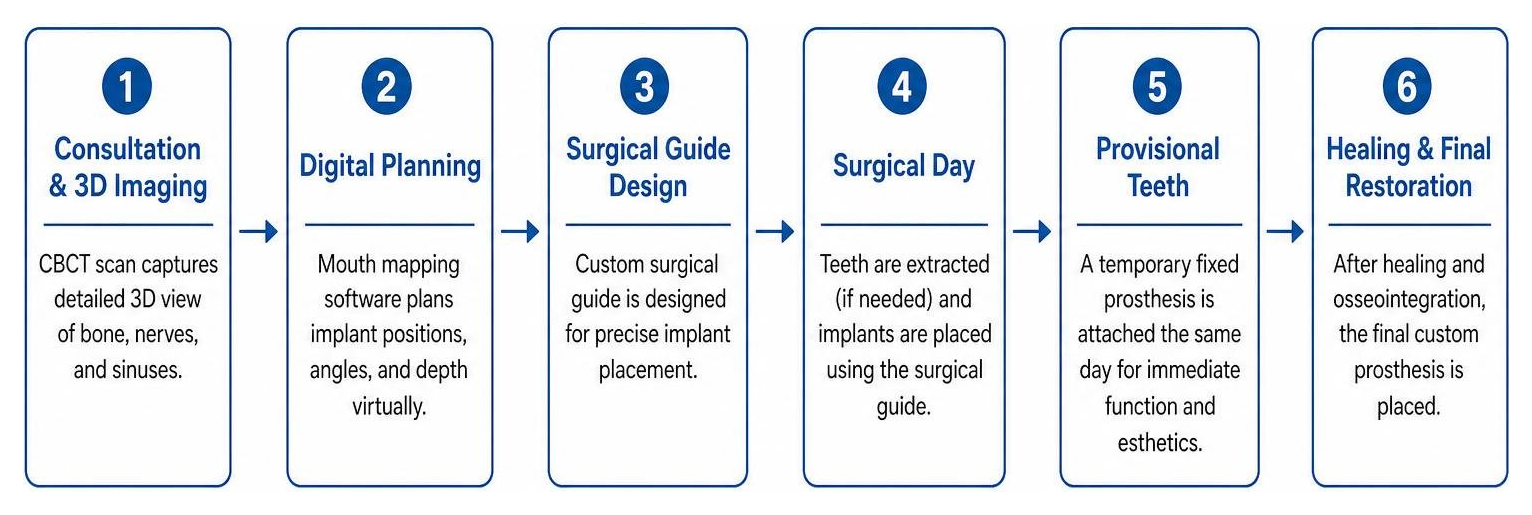
Your journey begins with a comprehensive consultation. We perform high-resolution 3D CBCT (Cone Beam Computed Tomography) imaging to capture a detailed, three-dimensional view of your jawbone, nerve pathways, and sinus cavities. Using advanced digital “Mouth Mapping” software, our team plans the exact placement, depth, and angle of each implant before the surgical day even arrives. This meticulous planning phase ensures the actual surgery is faster, safer, and minimally invasive.
Phase 2: The Surgical Day
On the day of surgery, we prioritize your absolute comfort. Under local anesthesia or deep IV sedation, any remaining failing or diseased teeth are gently extracted. The surgeon then places the implants with pinpoint accuracy using custom-designed surgical guides.
To understand the mechanical requirements and primary stability guidelines that make immediate loading possible on surgery day, you can read the clinical insights in the Immediate Full-Arch on 4/6 Implants guide by XGATE Dental.
Surgical Phase and Immediate Temporary Teeth for Full Arch Implants
One of the most remarkable aspects of modern full arch procedures is “Teeth-in-a-Day” or immediate loading. If the implants achieve a high level of primary stability during insertion (typically measured at a torque of 35 to 50 Ncm), we do not have to bury them under the gums to heal. Instead, we can attach a temporary prosthetic bridge to the implants immediately.
This temporary bridge serves several vital functions. Aesthetically, it ensures you never have to leave our office without a smile. Functionally, it allows you to speak clearly and eat a soft diet while your implants heal. Biomechanically, it splints the implants together, keeping them perfectly stable during the crucial early stages of osseointegration. To understand how these provisional restorations protect your healing jaw, read more about what an implant temporary bridge is and how it works.
Over the next three to six months, your jawbone will gradually grow around and bond to the titanium implant posts. During this healing phase, we monitor your progress closely, ensuring your gums heal beautifully and the implants become fully integrated into your skeletal structure.
Final Prosthesis Delivery and Material Options
Once your implants are fully integrated and your gum tissue has completely matured, we begin the process of fabricating your final, permanent prosthetic bridge. This is where art meets science. We take digital impressions of your mouth and design a bridge that perfectly matches your bite, facial symmetry, and aesthetic preferences.
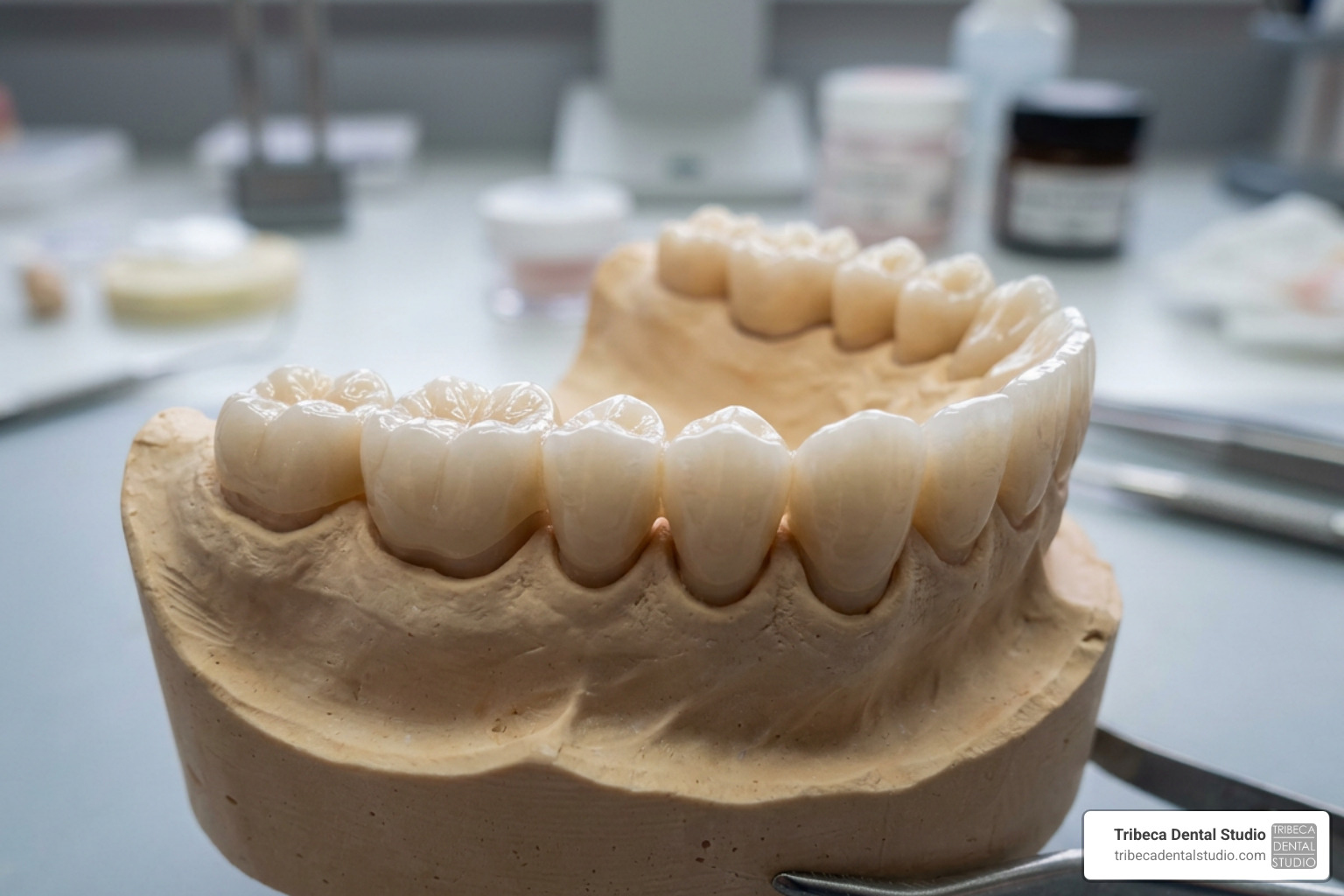
The choice of material for your final bridge is one of the most important decisions you will make. The three primary options include:
- Monolithic Zirconia: Widely considered the gold standard of modern restorative dentistry, zirconia is an incredibly strong, biocompatible ceramic. Milled from a solid block of zirconia using advanced CAD/CAM technology, these bridges are virtually chip-proof, highly resistant to staining, and offer an incredibly natural, lifelike translucency. To discover why this material is our top recommendation, read about why zirconia implants and restorations are the premium choice in NYC.
- Acrylic PMMA with a Metal Substructure: This option features a strong titanium or cobalt-chromium metal bar wrapped in a pink acrylic base with high-quality acrylic teeth. While it is more affordable and easier to repair than zirconia, acrylic is softer, meaning it is more prone to chipping, wearing down, and staining over time.
- Metal-Acrylic Hybrid (Toronto Bridge): This classic design utilizes a metal framework covered in a composite or acrylic cladding. It offers excellent shock absorption, making it a good choice for patients with a heavy bite, though it lacks the premium aesthetics and stain resistance of monolithic zirconia.
Candidacy, Longevity, and Safety of Full Arch Restorations
Most adults who are missing multiple teeth or facing widespread extractions are excellent candidates for full arch implants. However, because this is a surgical procedure, we must carefully evaluate your overall systemic health and oral hygiene habits.
Ideal candidates should have:
- Good general health to undergo minor surgical procedures
- Sufficient jawbone density (or be a candidate for zygomatic/pterygoid implants)
- Healthy gum tissue free of active, uncontrolled periodontal disease
- A commitment to maintaining excellent oral hygiene and attending regular dental cleanings
Certain medical conditions and lifestyle factors can affect the healing process and may temporarily or absolutely disqualify a patient. Uncontrolled diabetes, active cancer treatments, recent radiation therapy to the jaw, and severe immune deficiencies can hinder bone healing and increase the risk of implant failure.
Smoking is another significant risk factor; nicotine constricts blood vessels, reducing the oxygen and nutrients delivered to the healing bone and gums, which can double the rate of implant failure. If you struggle with active gum disease, our team will prioritize stabilizing your oral health with targeted periodontal care and deep cleanings before proceeding with implant surgery. To explore the clinical data behind these success rates, refer to the implant survival studies on PMC.
Longevity, Maintenance, and Aftercare
One of the most common questions patients ask is: How long will my new smile last?
With proper care, the titanium implant posts themselves are designed to last a lifetime. Because titanium is highly biocompatible, your bone will lock it in place permanently. The prosthetic bridge attached to the implants, however, is subject to daily wear and tear. A premium zirconia bridge can easily last 15 to 20 years or more with excellent maintenance, while acrylic-based bridges may require relining or replacement every 7 to 10 years.
Maintaining your full arch implants is straightforward, but it requires consistency. Because the bridge is fixed in place, you do not remove it at night. Instead, you care for it much like natural teeth:
- Brush twice daily with a soft-bristled toothbrush and non-abrasive toothpaste.
- Use a water flosser (oral irrigator) to flush out food particles and plaque from beneath the bridge.
- Use specialized super-floss or floss threaders to clean around the implant posts.
- Attend professional dental cleanings and exams every 3 to 6 months. During these visits, your hygienist will perform a specialized deep cleaning around the implants, and your dentist will verify that the bridge remains securely tightened and balanced. For a detailed checklist on protecting your investment, read our complete dental implant post-care guide.
Risks, Complications, and Success Rates
Every surgical procedure carries some level of risk, but full arch implant surgery boasts an exceptionally high success rate — typically between 95% and 98% when performed by experienced specialists.
Potential surgical risks include minor bleeding, temporary swelling, bruising, and infection at the implant site. These side effects are highly manageable and typically resolve within a week.
The primary long-term risk to dental implants is peri-implantitis, an inflammatory condition similar to gum disease. Peri-implantitis occurs when bacteria accumulate beneath the prosthetic bridge, leading to an infection that can damage the surrounding gum tissue and bone. If left untreated, peri-implantitis can cause the implant to lose its bone support and fail. This is why daily home hygiene and routine professional deep cleanings are so critical. To learn more about how we minimize these risks and ensure a safe, comfortable experience, read our guide on whether dental implants are safe.
Cost and Financing of Full Arch Implants in 2026
While full arch implants represent a significant financial investment, understanding the components of this treatment can help you navigate your options. In 2026, the national average cost for a fixed full arch implant bridge (All-on-4 or All-on-X) typically ranges from $20,000 to $50,000 per arch, depending on several key variables:
- The Number of Implants: An All-on-6 configuration will naturally cost more than an All-on-4 due to the additional hardware and surgical complexity.
- Prosthetic Materials: Upgrading from a standard acrylic PMMA bridge to a premium, computer-milled monolithic zirconia bridge generally adds several thousand dollars per arch, but offers vastly superior durability and aesthetics.
- Preparatory Procedures: Patients who require tooth extractions, extensive bone grafting, sinus lifts, or advanced zygomatic/pterygoid implants will face higher overall costs than those with pristine, dense jawbone structure.
- Sedation and Anesthesia: Choosing deep IV sedation or general anesthesia managed by a board-certified anesthesiologist will add to the surgical fees but ensures a completely pain-free, anxiety-free experience.
It is important to note that while traditional dental insurance plans rarely cover the entire cost of full arch restorations, many plans will partially cover specific components of the treatment, such as the initial consultations, 3D imaging, extractions, or a portion of the final prosthetic bridge.
Additionally, many patients utilize pre-tax funds from Health Savings Accounts (HSA) or Flexible Spending Accounts (FSA) to save significantly on out-of-pocket expenses. Third-party medical financing companies also offer flexible monthly payment plans to make this life-changing care highly accessible. To help you plan your budget, explore our detailed NYC dental implant cost guide.
Frequently Asked Questions about Full Arch Implants
How long do full arch implants last?
The medical-grade titanium implant posts are designed to permanently fuse with your jawbone and can easily last a lifetime with proper oral hygiene. The custom-designed prosthetic bridge that sits on top of the implants is subject to daily chewing forces; high-end monolithic zirconia bridges typically last 15 to 20+ years, while acrylic-hybrid bridges may need refurbishing or replacement every 7 to 10 years. To dive deeper into the factors that influence durability, read our guide on the lifespan of dental implants.
Is the full arch implant procedure painful?
No. The surgical procedure itself is completely painless. We perform the surgery under local anesthesia or deep IV sedation, meaning you will be entirely numb or asleep throughout the process. After the anesthesia wears off, it is normal to experience mild swelling, bruising, and minor discomfort for 3 to 7 days, which is highly manageable with over-the-counter or prescribed pain medications and a soft-food diet.
Can I get full arch implants if I have severe bone loss?
Absolutely. While severe bone loss once disqualified many patients, modern techniques have changed the game. Advanced solutions like angled implants, sinus lifts, bone grafting, and specialized zygomatic or pterygoid implants allow us to secure a stable foundation even in the most challenging cases. To learn more about how we rebuild a solid foundation, read about our dental implants for severe bone loss in Tribeca.
Conclusion
Widespread tooth loss or failing teeth can impact your self-confidence, your diet, and your long-term systemic health. Full arch implants offer a highly predictable, beautifully natural, and permanent solution that restores your smile from the root up.
At Tribeca Dental Studio in Manhattan, we believe that every patient deserves a personalized, compassionate approach to oral health. Led by Dr. Nina Izhaky and our board-certified implant specialist Dr. Sam Morhaim, we combine state-of-the-art digital technology with a warm, welcoming environment to deliver predictable, high-success outcomes. Whether you are looking to save your natural teeth with conservative smile design or are ready to transition to a permanent, gapless grin, our team is here to guide you every step of the way.
Ready to take the first step toward a healthy, confident smile? Restore your smile with Tribeca Dental Studio today.