When to Choose an Onlay Over a Full Crown
April 23, 2026
When Does a Tooth Need an Onlay vs Crown?
onlay vs crown is one of the most common decisions in restorative dentistry — and the right choice depends on how much of your tooth is damaged.
Here’s a quick answer:
| Onlay | Crown | |
|---|---|---|
| What it covers | One or more damaged cusps only | The entire visible tooth |
| Best for | Moderate damage with healthy walls still intact | Severe decay, fractures, or teeth after root canal |
| Tooth structure removed | 35–47% | 68–76% |
| Average cost (NYC) | $650–$1,200 | $800–$3,000 |
| Typical lifespan | 10–15+ years | 10–15+ years |
The short version: If your tooth still has solid, healthy walls, an onlay is usually the more conservative — and often better — choice. A crown makes more sense when the damage is extensive or the tooth has been structurally weakened.
Both restorations are durable, both look natural, and both are made in a dental lab from materials like porcelain or zirconia. The key difference is how much healthy tooth you keep.
Still, the decision isn’t always black and white. Factors like bite force, tooth location, grinding habits, and prior dental work all play a role in what’s right for your tooth.
I’m Dr. Nina Izhaky, a graduate of New York University College of Dentistry and the founder of Tribeca Dental Studio — a mercury-free, fully digital practice focused on personalized, conservative care. I’ve helped many patients navigate the onlay vs crown decision by using the latest diagnostic tools to find the option that protects the most healthy tooth structure for the long term.
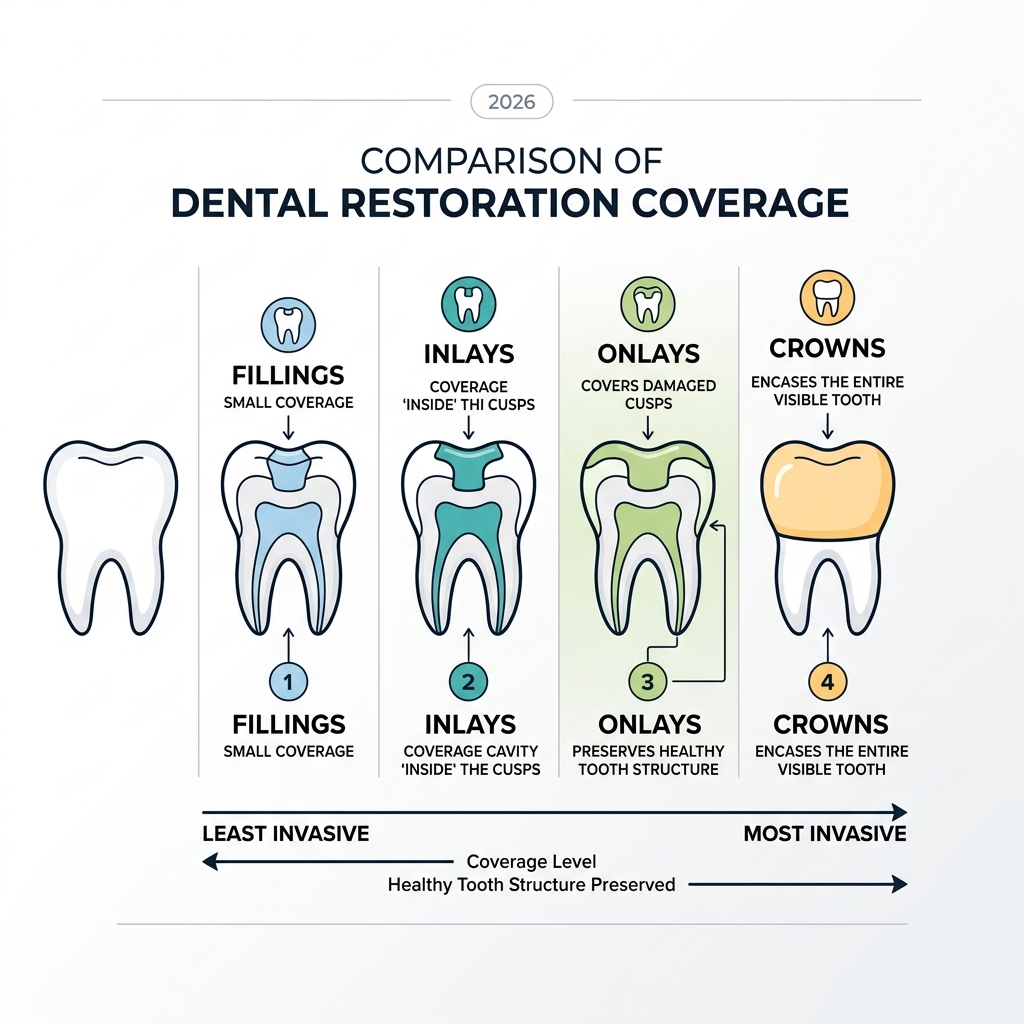
Learn more about onlay vs crown:
Onlay vs Crown: Understanding the Structural Differences
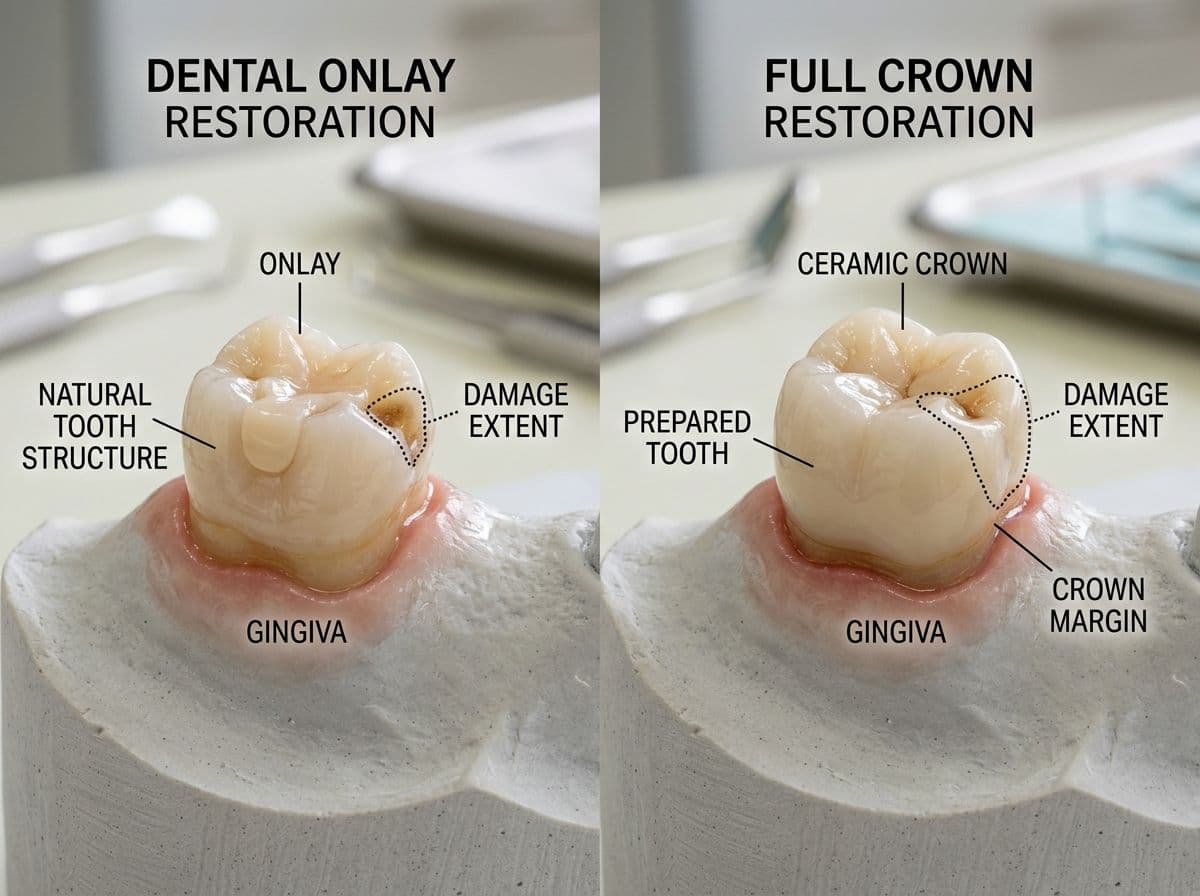
When we talk about the difference between an onlay vs crown, we are really talking about “coverage.” Think of a dental crown as a protective helmet that slides over the entire tooth down to the gum line. In contrast, an onlay is more like a custom-fitted structural patch that covers only the biting surface and the “cusps” (the raised points) of the tooth.
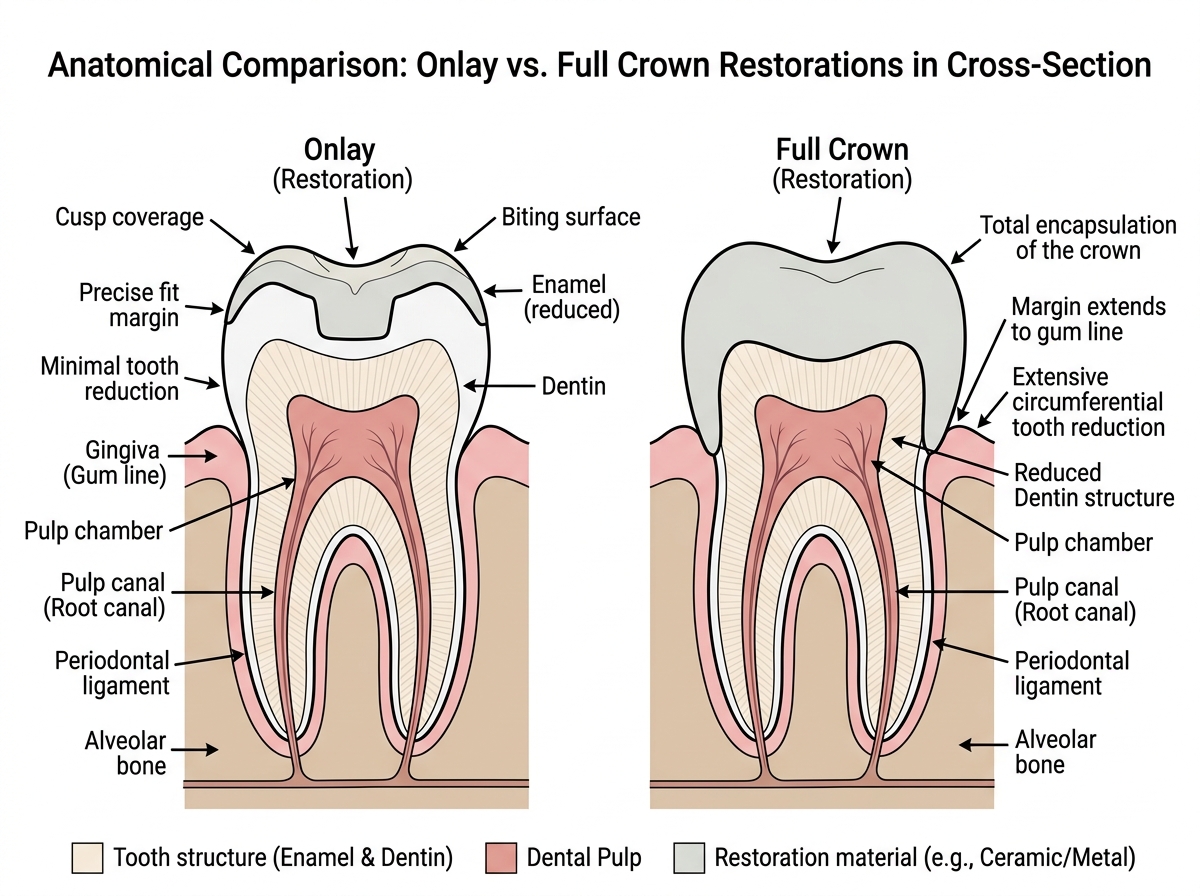
The primary mechanical difference lies in the “circumferential reduction.” To fit a crown, we must remove a significant portion of the tooth’s outer enamel and dentin around the entire perimeter. This creates a “stump” that the crown can grip. For an onlay, we only remove the damaged or decayed portions and a small amount of healthy structure to ensure the material has enough thickness to be strong.
According to a systematic review and analysis of studies, both restorations show high success rates, but they serve different structural purposes. At Tribeca Dental Studio, we often view onlays as the “middle ground” between a standard filling and a full-coverage crown. You can find more info about dental inlays and onlays on our dedicated service page, where we explain how these “partial crowns” provide a balance of strength and conservation.
The Benefits of an Onlay vs Crown for Back Teeth
Your molars and premolars are the workhorses of your mouth. Every time you chew, these teeth endure hundreds of pounds of pressure. This is why the onlay vs crown debate is most relevant for back teeth.
In many cases, an onlay is actually superior for a molar with moderate damage. Because an onlay is bonded directly to the tooth, it can actually help “tie” the remaining walls of the tooth together, reinforcing the natural structure. This is often more desirable than cutting away healthy walls just to fit a full cap. However, if the tooth has a vertical crack or has lost more than 50% of its volume, Manhattan dental crowns become the gold standard for preventing the tooth from splitting under pressure.
Preservation of Natural Tooth Structure
One of the most important concepts in modern dentistry is “minimally invasive” or “conservative” dentistry. The goal is to keep as much of your natural tooth as possible. Why? Because natural enamel and dentin are irreplaceable. They flex slightly under pressure, transmit sensory feedback, and have a unique bond with the supporting bone that artificial materials cannot perfectly replicate.
- Onlays typically preserve 60-80% of the natural tooth structure.
- Crowns typically preserve only 30-40% of the natural tooth structure.
The National Institute of Dental and Craniofacial Research notes that preserving natural tooth structure correlates with better long-term oral health outcomes. When we remove 60-75% of the visible tooth to place a crown, we are essentially “using up” our options. If that crown fails in 15 years, there is very little tooth left to work with. By choosing an onlay today, we leave more “savings” in your “tooth bank” for the future.
Clinical Criteria: When to Choose an Onlay vs. a Crown
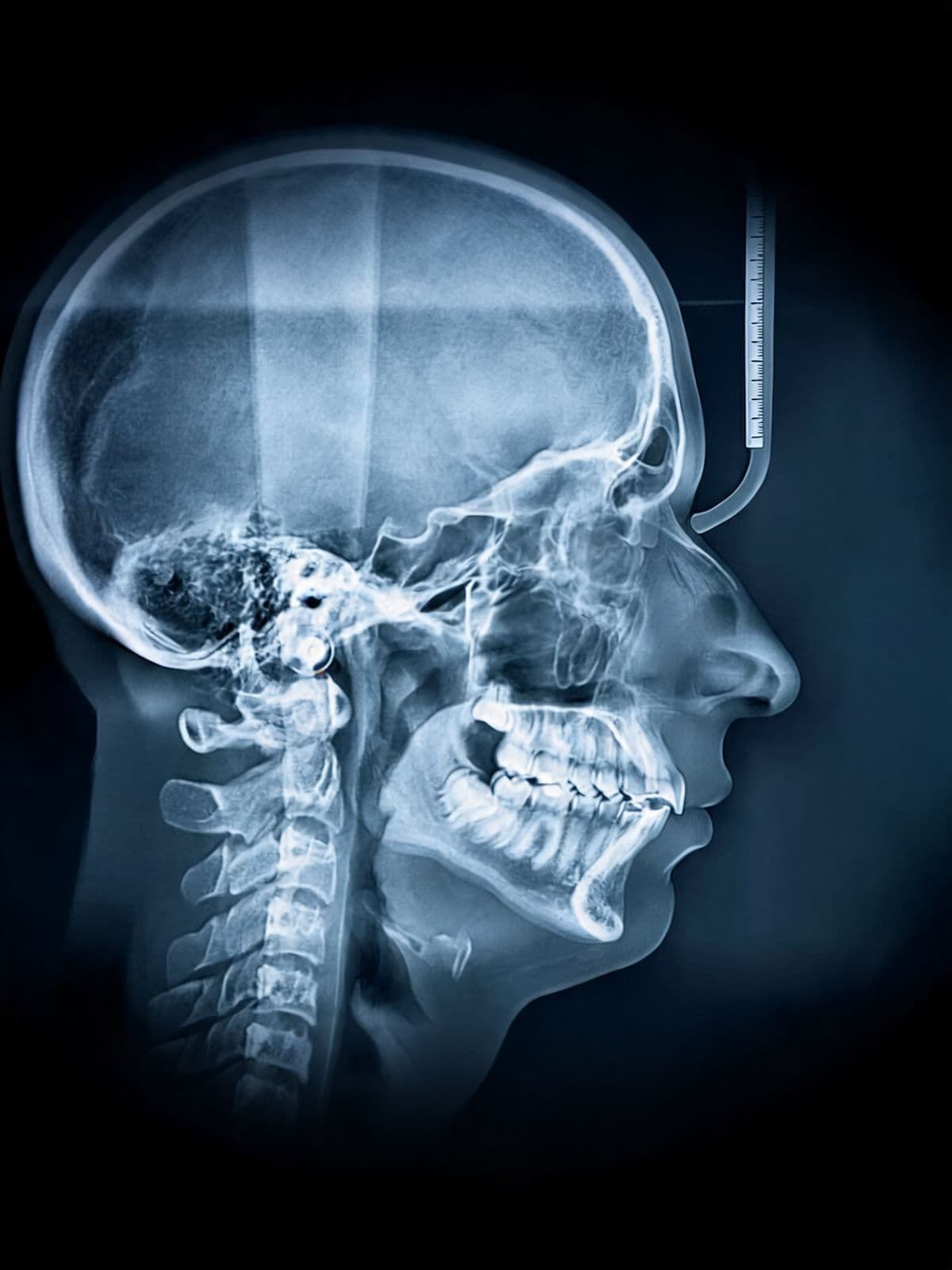
Deciding between an onlay vs crown involves a detailed clinical assessment. At Tribeca Dental Studio, we use digital X-rays and intraoral cameras to show you exactly what we see.
We generally recommend an onlay when:
- Decay or a fracture involves one or more cusps but the side walls of the tooth are still thick and healthy.
- A previous large filling has failed, leaving a cavity that is too wide for a new filling but hasn’t compromised the entire tooth.
- You want to preserve as much natural enamel as possible.
We generally recommend a crown when:
- The tooth has undergone root canal therapy. After a root canal, the tooth no longer has a blood supply, making it dehydrated and brittle — like a “hollow chocolate Easter bunny,” as some dentists say. A crown is essential to prevent it from shattering.
- There are deep fractures or cracks that extend toward the root.
- More than 50-60% of the tooth structure is missing due to decay or trauma.
- You have severe bruxism (teeth grinding) that requires the 360-degree protection a crown provides.
A scientific review of onlays vs crowns suggests that while onlays are excellent for conservation, crowns offer more “predictability” in high-stress situations. If we determine you need a dental crown after a filling has failed, it’s usually because the remaining tooth “walls” are too thin to support the biting forces on their own.
Comparing Materials, Costs, and Longevity
The materials used for both restorations have come a long way. Gone are the days when you had to choose between a “gold tooth” or an “ugly metal filling.”
- Porcelain/Ceramic: These are the most common for NYC patients who want a natural look. They are color-matched to your surrounding teeth and are highly resistant to staining.
- Zirconia: This is a “powerhouse” material. It is incredibly strong and ideal for patients who grind their teeth or for back molars that do the heavy lifting.
- Gold Alloys: While less popular for aesthetic reasons, gold is still the most durable material available. It expands and contracts at a rate similar to natural teeth and can last 20-40 years.
- Composite Resin: Sometimes used for onlays, this is a more affordable option but is generally less durable than ceramic or zirconia.
At Tribeca Dental Studio, we prioritize materials that offer both beauty and longevity. However, even the best material can feel “off” initially. If you find your crown is sensitive to cold and hot after placement, it’s often just a temporary inflammation of the nerve or a minor bite adjustment that we can easily fix in the office.
Long-Term Oral Health: Onlay vs Crown Outcomes
In terms of lifespan, both onlays and crowns are designed to last between 10 and 15 years, though many last much longer with excellent home care.
Research on the survival rates of resin and ceramic inlays and onlays shows that onlays achieve survival rates of roughly 90% at 10 years, which is very comparable to full crowns. The “marginal integrity” — or how well the restoration meets the natural tooth — is key. Because onlays have shorter margins (the “seam” where the porcelain meets the tooth), they can sometimes be easier to keep clean than a crown that goes all the way under the gum line, potentially leading to better gum health.
Cost-Benefit Analysis for Patients
In New York City, the upfront cost of an onlay vs crown can vary. Generally, an onlay is slightly less expensive than a crown because it requires less material and less intensive tooth preparation. However, because onlays require high levels of precision and laboratory artistry, the price difference isn’t always massive.
- Onlay Cost: $650 – $1,200
- Crown Cost: $800 – $3,000
When considering the cost, we encourage patients to look at the “cost-per-year.” A $1,500 crown that lasts 15 years costs only $100 per year to protect your tooth. Furthermore, choosing an onlay now might save you the cost of an extraction and dental implant ($4,000+) down the road by preserving your natural root and tooth structure for longer.
Insurance coverage is another factor. Most NYC insurance plans cover crowns at about 50% after your deductible. Some plans are slightly more restrictive with onlays, classifying them as “basic” or “major” depending on the specific policy. Our team at Tribeca Dental Studio works closely with your insurance provider to maximize your benefits regardless of which option you choose.
Frequently Asked Questions about Onlays and Crowns
Can I get a same-day onlay or crown?
Yes! Modern CAD/CAM technology (like CEREC) allows some dental offices to mill a restoration right in the office. At Tribeca Dental Studio, we utilize digital impressions — no more goopy trays! — to ensure the highest level of precision. While some complex cases still benefit from a master lab technician’s hand-finishing, many restorations can be designed and placed in a much shorter timeframe than in the past.
How long do these restorations typically last?
As mentioned, 10-15 years is the standard expectation. However, your habits play a huge role. If you chew ice, bite your nails, or use your teeth as tools to open packages, any restoration (and your natural teeth!) will fail sooner. For patients with bruxism, we almost always recommend a custom night guard to protect your investment from the immense forces of nighttime grinding.
Is the procedure for an onlay more painful than a crown?
Not at all. Both procedures are performed under local anesthesia, meaning you won’t feel a thing during the preparation. Because onlays are more conservative and involve removing less tooth structure near the nerve, some patients actually report less post-operative sensitivity compared to a full crown. Most patients are back to eating normally within a day or two, though we recommend staying away from very sticky or hard foods while you have a temporary restoration in place.
Conclusion
The choice between an onlay vs crown shouldn’t be a source of stress. Both are excellent, time-tested ways to save a damaged tooth and restore your smile’s function. The “best” choice is simply the one that addresses your specific dental needs while keeping your long-term oral health in mind.
At Tribeca Dental Studio, Dr. Nina Izhaky and our entire team are dedicated to a personalized approach. We don’t believe in “one-size-fits-all” dentistry. Whether you need a conservative onlay to fix a broken cusp or a durable zirconia crown to protect a tooth after a root canal, we treat you like family, using the most advanced technology available in Manhattan.
Don’t wait for a small crack to become a big problem. Schedule a consultation for dental crowns and bridges or onlays today, and let us help you choose the restoration that’s right for your smile.