Why Your Narrow Palate Deserves More Attention Than You’re Giving It
Narrow palate treatment covers a range of orthodontic and surgical options designed to widen a too-narrow upper jaw — and the right approach depends almost entirely on your age and bone structure.
Quick answer: What are the main narrow palate treatment options?
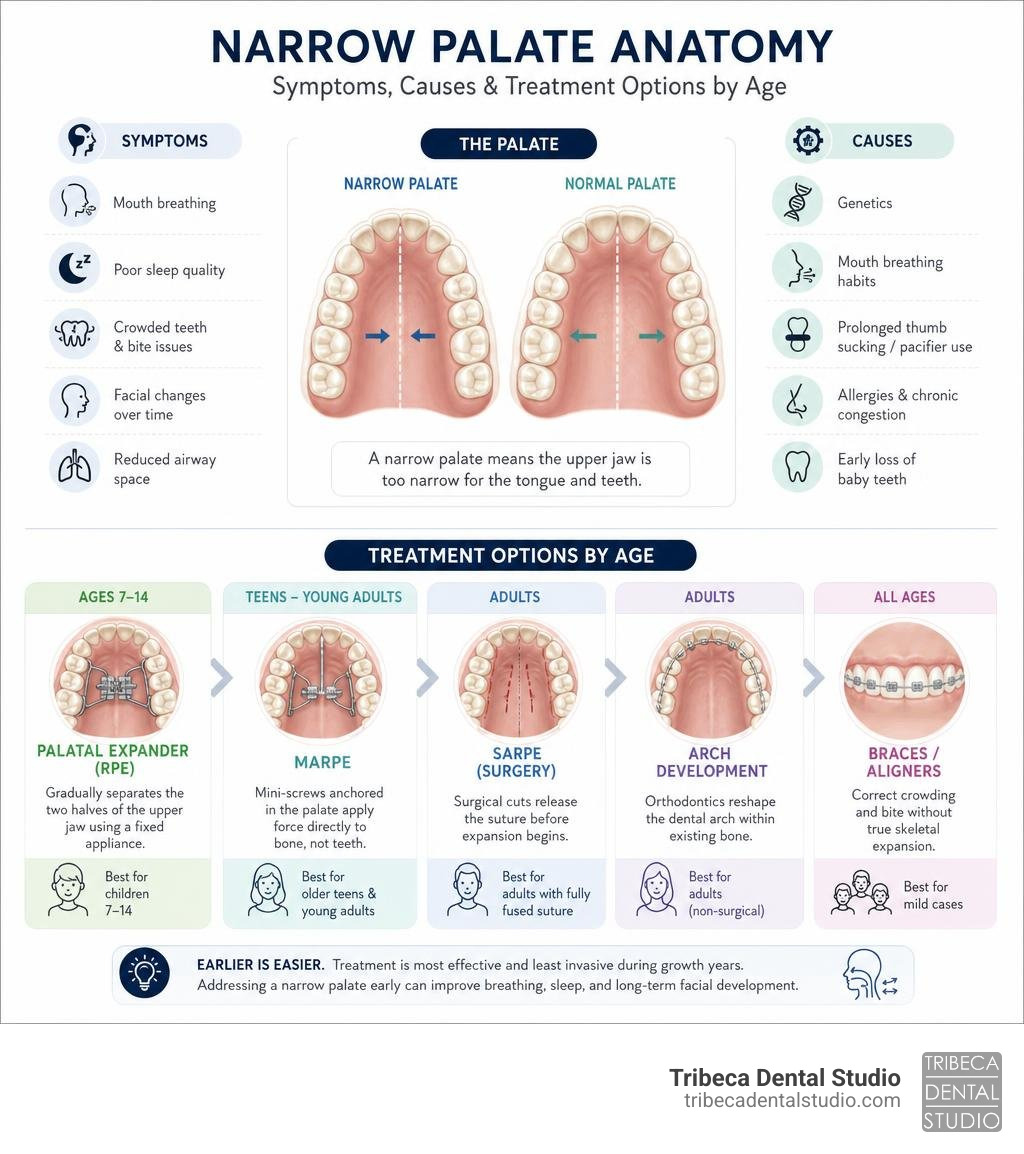
| Treatment | Best For | How It Works |
|---|---|---|
| Palatal expander (RPE) | Children ages 7–14 | Gradually separates the two halves of the upper jaw using a fixed appliance |
| MARPE | Older teens and adults | Mini-screws anchored in the palate apply force directly to bone, not teeth |
| SARPE (surgery) | Adults with fully fused palatal suture | Surgical cuts release the suture before expansion begins |
| Arch development | Adults (non-surgical) | Orthodontics reshape the dental arch within existing bone |
| Braces / aligners | Mild cases | Correct crowding and bite without true skeletal expansion |
Here’s the thing most people don’t realize: a narrow palate isn’t just a cosmetic issue. It can quietly affect how you breathe, how you sleep, and how your face develops — often for years before anyone connects the dots.
Roughly 10% of adults have maxillary transverse deficiency (the clinical name for a narrow upper jaw). Many of them were never treated as children, when correction is simplest. The longer it goes unaddressed, the more complex — and more expensive — the fix becomes.
This guide breaks down every treatment option, from early childhood expansion to advanced adult techniques, so you can understand what’s actually possible at your stage of life.
I’m Dr. Nina Izhaky, a graduate of New York University College of Dentistry and founder of Tribeca Dental Studio — a fully digital, comprehensive practice in the heart of Tribeca where narrow palate treatment is one of the many areas our team approaches with precision and care. With every specialist available on-site and a commitment to the most current techniques, we’re here to make sure your treatment plan fits you — not a one-size-fits-all protocol.
Handy narrow palate treatment terms:
Understanding Maxillary Transverse Deficiency
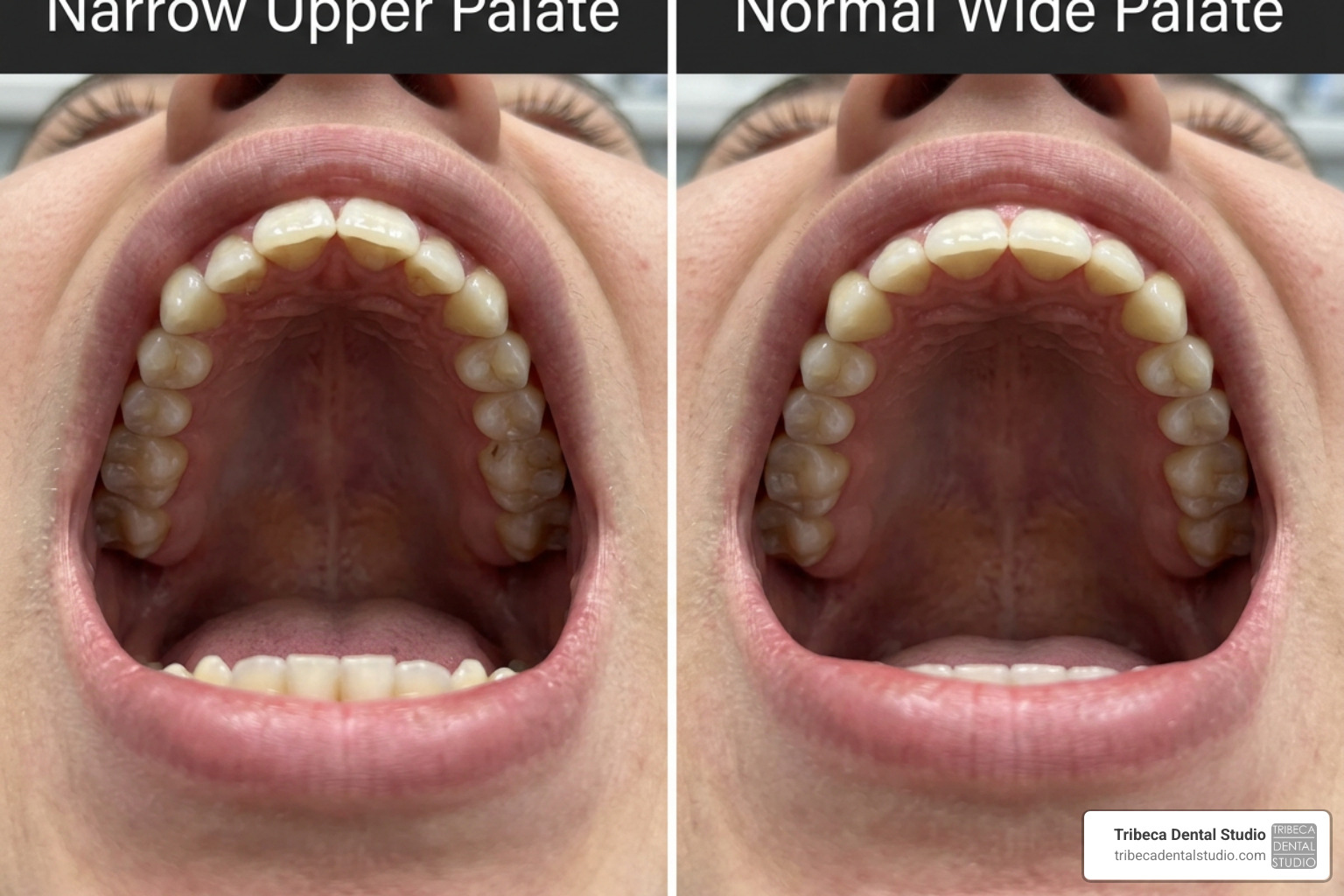
When we talk about a narrow palate, we are clinically referring to maxillary transverse deficiency (MTD). This condition means the upper jaw (the maxilla) is structurally too narrow relative to the rest of the skull and the lower jaw. Because the roof of the mouth also serves as the floor of the nasal cavity, a narrow palate is fundamentally a structural restriction of your airway.
How does a palate end up narrow in the first place? It is usually a combination of environmental factors and genetic programming:
- Genetics: Often, the structural blueprint of your jaw is inherited. If one or both parents have a narrow dental arch or a history of orthodontic crowding, there is a high likelihood their children will inherit a similar skeletal pattern.
- Mouth Breathing: Under normal conditions, breathing through the nose keeps the mouth closed. When you breathe through your mouth due to allergies, enlarged tonsils, or adenoids, the jaw drops, and the tongue rests on the floor of the mouth rather than the roof.
- Improper Tongue Posture: Your tongue is nature’s built-in palatal expander. When resting properly against the roof of the mouth, it exerts outward lateral force that guides the widening of the maxilla during development. Without this upward pressure, the constant inward force of the cheek muscles goes unopposed, causing the upper jaw to collapse inward.
- Childhood Habits: Prolonged thumb-sucking, tongue thrusting, or extended pacifier use after age four can physically deform the soft, developing bones of the upper jaw, pulling the palate upward into a high, narrow arch.
When the upper jaw is too narrow, it cannot easily accommodate all of the permanent teeth. This leads to dental crowding, overlapping, and impacted teeth (especially the canines). It also prevents the upper and lower teeth from meeting correctly, resulting in a crossbite (where the upper teeth bite inside the lower teeth).
Recognizing the Need for Narrow Palate Treatment
Identifying a narrow palate early can prevent a lifetime of downstream health issues. While a dentist can easily spot the signs during a routine examination, there are several key symptoms you can look out for at home:
- Oral Symptoms: Severe crowding of the upper teeth, a high-arched or “gothic” palate, and a narrow dental arch that leaves dark spaces (buccal corridors) at the corners of your mouth when you smile.
- Bite Issues: A posterior crossbite, which often causes the lower jaw to shift to one side when closing, leading to facial asymmetry.
- Breathing and Sleep Issues: Chronic mouth breathing, loud snoring, restless sleep, and obstructive sleep apnea (OSA). Because a narrow palate restricts the nasal airway, patients are forced to breathe through their mouths, especially at night.
- Functional Issues: Difficulty chewing, speech challenges or minor articulation differences (due to limited tongue space), and unexplained headaches linked to temporomandibular joint (TMJ) strain.
If you notice these signs in yourself or your child, it is highly recommended to seek an evaluation. To explore how we approach these issues with minimal anxiety, check out this guide on More info about fixing a narrow palate without stress.
Skeletal vs. Dental Narrowness
A crucial step in planning narrow palate treatment is distinguishing between skeletal narrowness and dental narrowness.
- Skeletal Narrowness: This is a true bone deficiency where the maxilla itself is structurally narrow. To correct this, we must physically separate the midpalatal suture — the fibrous joint that runs down the middle of the roof of the mouth. This allows new bone to regenerate in the gap, permanently widening the skeletal base.
- Dental Narrowness: In this scenario, the underlying jawbone is actually a normal width, but the teeth themselves are tipped inward, making the arch appear narrow.
If a clinician misdiagnoses skeletal narrowness as dental narrowness and attempts to resolve it simply by tipping the teeth outward with standard braces or clear aligners, the roots of the teeth can be pushed right out of the supporting alveolar bone. This leads to gum recession, tooth instability, and rapid orthodontic relapse.
To prevent this, our team at Tribeca Dental Studio takes comprehensive diagnostic records. We utilize advanced cone-beam computed tomography (CBCT) scans, high-resolution digital models, and extraoral photographs to evaluate the exact relationship between your teeth and your skeletal base before recommending any treatment.
Age-Specific Narrow Palate Treatment Options
In orthodontics, timing is everything. The midpalatal suture remains open and highly malleable throughout childhood. However, as we approach late adolescence, this suture begins to interlock and ossify. In girls, fusion typically occurs between ages 14 and 17, and slightly later in boys.
By the time we reach adulthood, the suture is fully fused, meaning gentle orthopedic pressure will no longer separate the bones. Instead, it will only tip the teeth.
Because the biology of the jaw changes so drastically with age, our treatment methods must change accordingly:
| Feature | Rapid Palatal Expansion (RPE) | Microimplant-Assisted (MARPE) | Surgically Assisted (SARPE) |
|---|---|---|---|
| Primary Target Age | Children (Ages 7–14) | Older Teens & Adults (Ages 15–30+) | Adults with severe deficiency |
| Anchorage Method | Tooth-borne (bands on molars) | Bone-borne (mini-screws in palate) | Tooth/bone-borne + surgical cuts |
| Suture Status | Completely open | Partially fused / closed | Fully fused & locked |
| Invasiveness | Non-invasive | Minimally invasive (local anesthetic) | Surgical procedure (general anesthesia) |
| Main Benefit | Highly predictable, easy bone growth | Avoids jaw surgery in mature patients | Predictable for extreme skeletal discrepancies |
For a deeper dive into the mechanics of skeletal expansion, you can read More info about maxillary skeletal expansion.
Pediatric Interventions: Palatal Expansion for Children
The American Association of Orthodontists recommends that children receive their first orthodontic evaluation by age 7. This is the absolute golden window for narrow palate treatment.
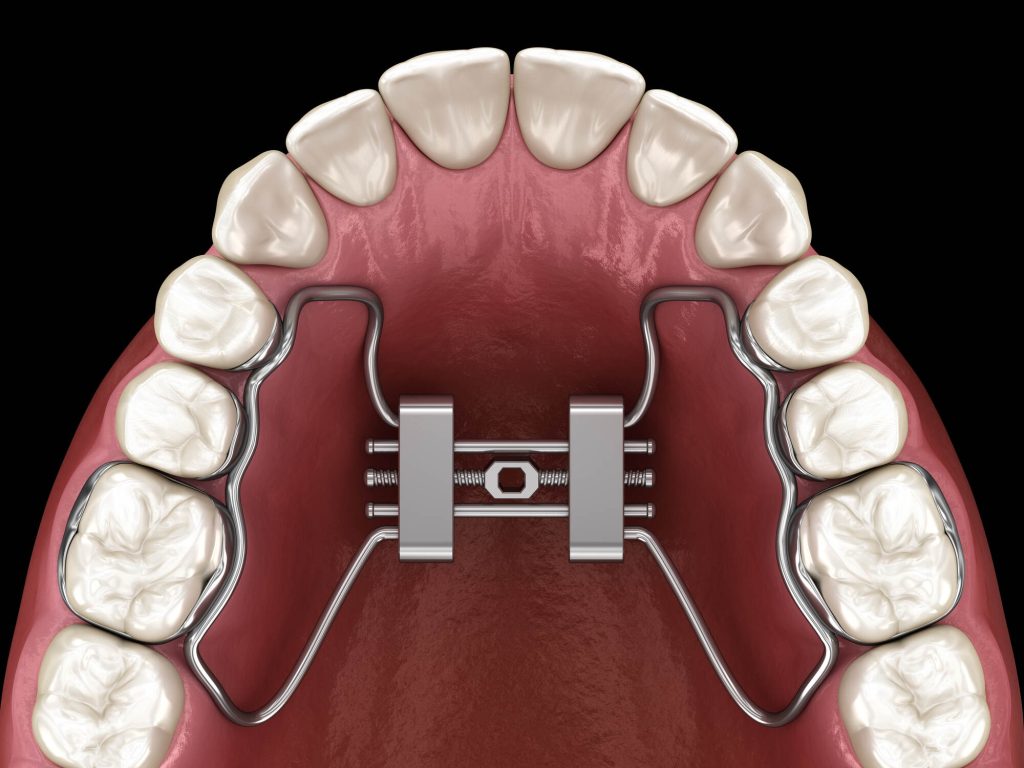
At this developmental stage, the midpalatal suture is still soft and held together by connective tissue. We can utilize a traditional Rapid Palatal Expander (RPE). This tooth-borne appliance is custom-fit to the child’s upper molars. By turning a small screw in the center of the appliance daily, gentle lateral force is applied. Because the suture is open, the two halves of the maxilla slide apart easily, and the body naturally fills the gap with new bone.
This Phase 1 orthodontic intervention takes advantage of active growth to:
- Eliminate posterior crossbites and prevent asymmetric jaw growth.
- Create natural space for erupting permanent teeth, frequently eliminating the need for healthy tooth extractions later in life.
- Widen the nasal cavity floor, instantly improving nasal airflow and resting oral posture.
The active expansion phase typically takes only a few weeks, followed by a consolidation period of 4 to 6 months to allow the new bone to fully mature. To learn more about how this non-surgical approach benefits young patients, explore More info about palatal expansion for children.
Adult Interventions: Advanced Narrow Palate Treatment
Once skeletal maturity is reached in adulthood, traditional RPEs are no longer effective. If you apply heavy expansion forces strictly to adult teeth, you will cause dental tipping, root damage, and bone loss rather than skeletal widening.
Fortunately, modern adult orthodontics offers advanced, highly successful alternatives to traditional jaw surgery:
- MARPE (Microimplant-Assisted Rapid Palatal Expansion): This minimally invasive technique bypasses the teeth entirely. By anchoring the expansion appliance directly into the palatal bone using temporary mini-screws (microimplants), we can apply direct lateral force to the skeletal structure. This allows us to successfully split the midpalatal suture and expand the jaw in skeletally mature patients without surgery.
- SARPE (Surgically Assisted Rapid Palatal Expansion): For patients with highly fused sutures or severe skeletal discrepancies, a surgical assist is required. A surgeon performs a subtotal Le Fort I osteotomy to carefully release the fused bony connections of the maxilla. Once the bone is mobilized, an expansion device is activated to gradually widen the arch. You can read the clinical details of this procedure in this guide on Surgically assisted rapid palatal expansion for Transverse hypoplasia of maxilla.
For adults seeking non-surgical airway improvements, we highly recommend reading More info about adult airway dentistry.
The Science of MARPE: CBCT Planning and Personalized Appliances
The success of MARPE relies heavily on precise digital planning. Because every patient’s palatal anatomy is entirely unique, a one-size-fits-all approach can lead to complications, such as microimplant failure or nasal mucosa irritation.
At Tribeca Dental Studio, we utilize state-of-the-art Cone-Beam Computed Tomography (CBCT) to map the exact three-dimensional landscape of your palatal bone.
By combining CBCT scans with high-resolution intraoral digital impressions, we can design a personalized, CAD/CAM-fabricated MARPE appliance. This digital workflow allows us to:
- Identify the areas of highest bone density and thickness for microimplant placement.
- Determine the ideal length and angle for each mini-screw to ensure maximum stability.
- Avoid vital anatomical structures, such as the incisive canal and the nasal cavity floor.
This personalized approach has revolutionized adult treatment. To see the scientific evidence behind this technology, you can read the CBCT-based personalized MARPE study.
Overcoming Thin Palatal Bone Challenges
One of the greatest historical challenges of adult palatal expansion was treating patients with thin palatal bone. Standard microimplants generally require at least 5 mm of bone support for reliable retention, with a minimum overall palatal bone thickness of 4 mm recommended for conventional stability.
However, a landmark clinical study of 18 adult patients with severe maxillary transverse deficiency and critically thin palatal bone (averaging less than 2.5 mm) demonstrated that personalized, CBCT-guided MARPE treatment achieved a 100% success rate with zero implant failures.
The study highlighted several critical parameters for microimplant stability:
- Cortical Bone Thickness: A cortical bone thickness exceeding 1.5 mm is vital to prevent micro-wobbling of the screws during activation.
- Bone Engagement: Higher success rates of midpalatal suture opening are consistently reported when microimplants engage more than 4.5 mm of stable palatal bone.
- Custom Placement: By digitally shifting the microimplants slightly away from the thin midline and closer to the thicker alveolar bone of the posterior palate, clinicians can securely anchor the appliance even in highly compromised skeletal environments.
To discover how we utilize these advanced mechanics for our adult patients in Manhattan, explore More info about MARPE benefits and techniques.
Skeletal, Dental, and Airway Changes After Treatment
When we expand a narrow palate, the biological and aesthetic changes extend far beyond simply straightening crooked teeth. The entire craniofacial complex undergoes a beautifully coordinated remodeling process.
Following a personalized MARPE protocol, patients experience remarkable skeletal changes:
- Nasal Cavity Widening: The landmark study on thin-boned patients showed a mean increase of 5.19 mm in anterior nasal spine width and 4.49 mm in posterior nasal spine width. This represents a massive physical expansion of the primary breathing passage.
- Maxillary Basal Width: The same study reported a mean increase of 4.05 mm in the overall maxillary basal width, providing a broad, stable skeletal foundation.
- Facial Height & Angles: Patients experienced a significant increase in anterior facial height of 2.00 mm, alongside notable improvements in skeletal profiles, including positive changes in the SNA and ANB angles (0.57° and 1.54°, respectively).
- Zygomaticomaxillary Remodeling: The expansion forces gently stimulate three-dimensional remodeling of the zygomaticomaxillary complex (the cheekbone area), which often translates to improved midface support and a subtle, natural lifting effect of the cheeks.
Once the active expansion is complete, the expander must remain in place for a consolidation period of at least 6 months. This retention phase is absolutely critical; it gives the body the necessary time to deposit new, dense bone into the expanded suture, ensuring the results remain stable for a lifetime.
To learn more about how we coordinate these structural changes with comprehensive facial aesthetics, see More info about airway orthodontics.
Airway and Sleep Quality Improvements
Perhaps the most life-changing benefit of narrow palate treatment is its direct, positive impact on airway function. Because the roof of the mouth is the floor of the nose, widening a narrow palate instantly reduces nasal airflow resistance.
When nasal breathing is restored:
- Mouth breathing is eliminated: The tongue can finally adopt its natural resting posture against the newly widened palate.
- The airway is stabilized: With the tongue resting up and forward, it no longer collapses backward into the throat during sleep, which is the primary trigger for snoring and obstructive sleep apnea.
- Sleep quality skyrockets: Patients transition from shallow, fragmented sleep to deep, restorative REM cycles. This drastically reduces daytime fatigue, brain fog, and long-term cardiovascular strain.
Whether we are helping an adult reclaim their energy or setting a child up for healthy growth, airway-focused treatment is a cornerstone of our practice. For parents looking out for their children’s development, read More info about pediatric airway dentistry.
Frequently Asked Questions About Narrow Palate Treatment
Is palatal expansion painful for adults?
While the idea of widening your jawbone might sound daunting, the process is remarkably well-tolerated. For MARPE, the microimplants are placed under comfortable local anesthesia. During the active expansion phase (which usually lasts 3 to 4 weeks), patients typically report a sensation of pressure or tightness across the bridge of the nose and the cheekbones for a few minutes after turning the key, rather than sharp pain. This is easily managed with over-the-counter pain relievers if needed.
How long does the expansion process take?
The active expansion phase — where you turn the key to physically widen the appliance — is surprisingly fast, typically lasting only 3 to 4 weeks. However, the entire appliance must remain in your mouth for a consolidation period of approximately 6 months to allow new bone to completely fill and stabilize the gap. After the expander is removed, we transition to standard braces or clear aligners to perfectly align the teeth, which usually takes an additional 12 to 18 months.
Will narrow palate treatment change my facial appearance?
Yes, but in a highly positive, balanced way! Palatal expansion broadens your dental arch, which fills out the “dark corridors” at the corners of your mouth, creating a wide, radiant, and youthful smile. Skeletally, it provides better support for the cheeks and lips, which can soften deep nasolabial folds and improve overall facial symmetry. It does not make your face look unnaturally wide; rather, it restores the natural horizontal proportions of your midface.
Conclusion
A narrow palate is far more than a cosmetic concern; it is a structural limitation that impacts your breathing, your sleep, and your long-term health. Whether you are exploring early intervention for your child or seeking advanced, non-surgical adult expansion options, our team at Tribeca Dental Studio is committed to delivering predictable, life-changing outcomes.
Led by Dr. Nina Izhaky, our warm and welcoming Tribeca practice treats every patient like family. We bring together a highly experienced, multidisciplinary team of specialists under one roof, allowing us to seamlessly coordinate everything from advanced digital diagnostics and custom MARPE designs to comprehensive airway orthodontics. For complex cases requiring specialized surgical expertise, we work hand-in-hand with leading specialists like Dr. Sam Morhaim to ensure the highest standards of care.
Beyond structural expansion, our practice is widely recognized for advanced implant dentistry and specialized zygomatic implant care, providing comprehensive skeletal and dental reconstruction for even the most challenging cases. We stand behind the quality of our work and are dedicated to helping you achieve a healthy, beautifully balanced smile that supports your overall well-being.
Ready to take the first step toward breathing easier and smiling wider? Schedule a personalized consultation with us today by visiting More info about airway orthodontics services.