What You Need to Know About Chipped Tooth Enamel Repair
Chipped tooth enamel repair is something millions of people need — and the good news is that dentistry in 2026 makes it faster, more natural-looking, and more accessible than ever.
Here’s a quick overview of your main repair options:
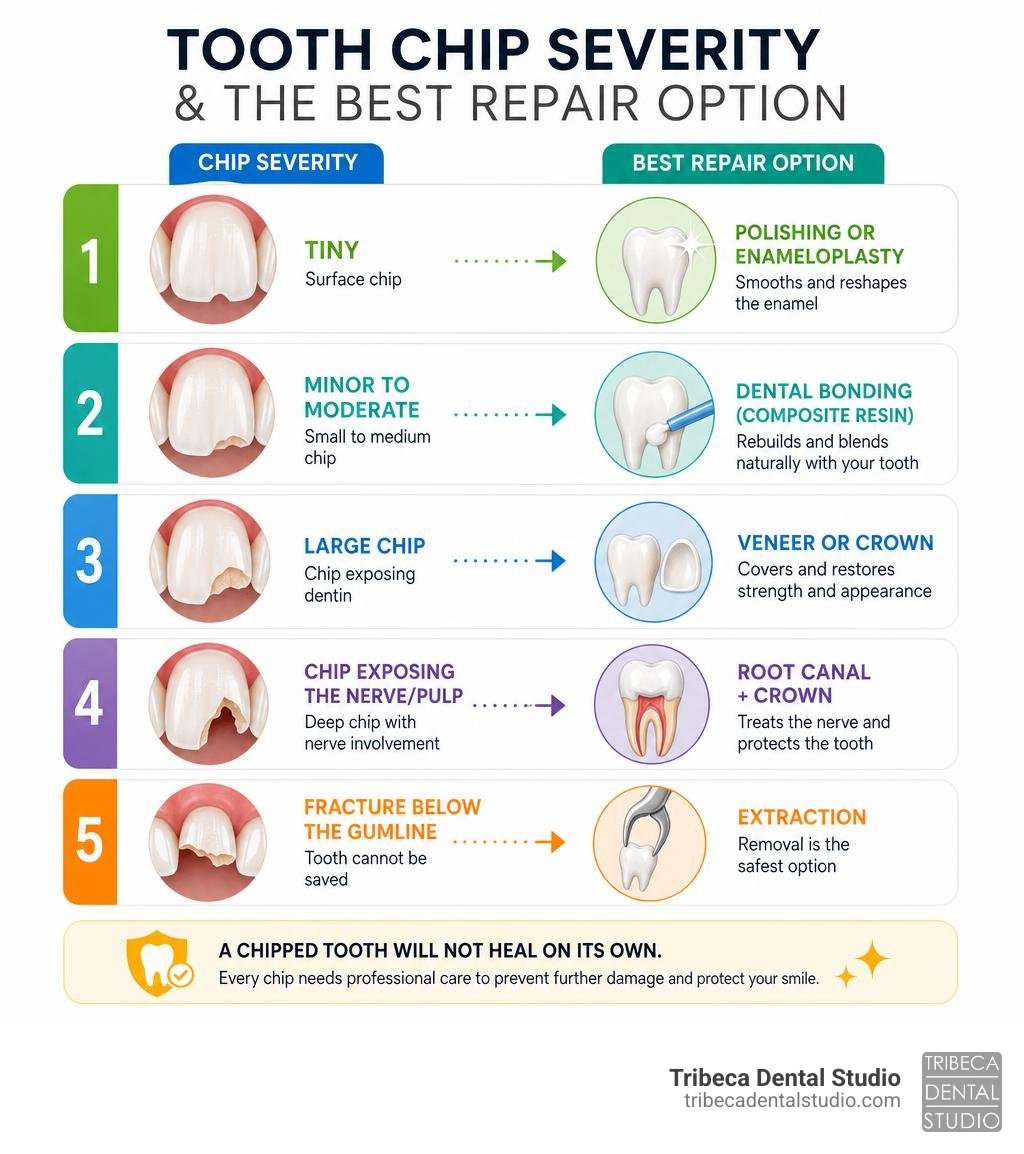
| Chip Severity | Best Treatment Option | Visits Needed |
|---|---|---|
| Tiny surface chip | Polishing or enameloplasty | 1 |
| Minor to moderate chip | Dental bonding (composite resin) | 1 |
| Large chip exposing dentin | Veneer or crown | 1-2 |
| Chip exposing the nerve/pulp | Root canal + crown | 2+ |
| Fracture below the gumline | Extraction | 1-2 |
One important thing to know upfront: a chipped tooth will not heal on its own. Unlike bones, teeth have no blood supply that allows them to self-repair. Every chip — no matter how small it looks — needs a dentist’s attention to prevent it from getting worse.
Enamel is the hardest substance in the human body, but it is not indestructible. A single bite on something hard, a sports knock, or years of grinding can be enough to break a piece off. Once it’s gone, it’s gone — but a skilled dentist can restore the look, strength, and function of your tooth so well that no one will ever know.
I’m Dr. Nina Izhaky, a graduate of New York University College of Dentistry and founder of Tribeca Dental Studio, where chipped tooth enamel repair is one of the most common cosmetic and restorative treatments I provide using the latest digital and mercury-free techniques. Read on for everything you need to make a confident, informed decision about restoring your smile.
Chipped tooth enamel repair terminology:
Understanding Enamel Damage: Causes and Types of Chips
To understand how we approach chipped tooth enamel repair, it helps to look at what your teeth are made of. Your teeth have three primary layers:
- Enamel: The tough, mineralized outer shell. It has no nerves or blood vessels, which is why minor enamel-only chips usually do not hurt.
- Dentin: The softer, yellow layer beneath the enamel. It contains microscopic tubules that lead directly to the tooth’s nerve. If a chip is deep enough to expose dentin, you will likely feel sensitivity to cold, hot, or sweet foods.
- Pulp: The living center of the tooth, containing nerves and blood vessels. If a chip or crack reaches this layer, it can cause severe, throbbing pain and requires immediate emergency treatment.
What Causes a Tooth to Chip?
Even though enamel is incredibly strong, daily wear and tear can weaken it over time. Some of the most common reasons we see patients in our office with chipped teeth include:
- Biting down on hard objects: Crunching on ice, hard candies, popcorn kernels, or accidentally biting a fork can instantly snap off a piece of enamel.
- Facial trauma: Sports injuries, accidental falls, or car accidents are frequent culprits, particularly for front teeth.
- Bruxism (Teeth Grinding): Chronic clenching and grinding put immense, uneven pressure on your teeth, creating micro-fractures that eventually turn into visible chips.
- Acid erosion: Frequent exposure to acid from sour foods, sodas, or medical conditions like GERD (acid reflux) slowly dissolves enamel, making it thin, brittle, and highly susceptible to breakage.
- Using teeth as tools: Using your teeth to open packages, rip tape, or hold nails is a fast track to a dental emergency.
- Age and existing dental work: Teeth naturally weaken as we age, especially after age 50. Additionally, teeth with large, old fillings have less natural structure, making them more prone to fracturing.
The Different Types of Tooth Cracks and Chips
Not all dental fractures are created equal. Dentists categorize tooth damage to determine the most effective treatment plan:
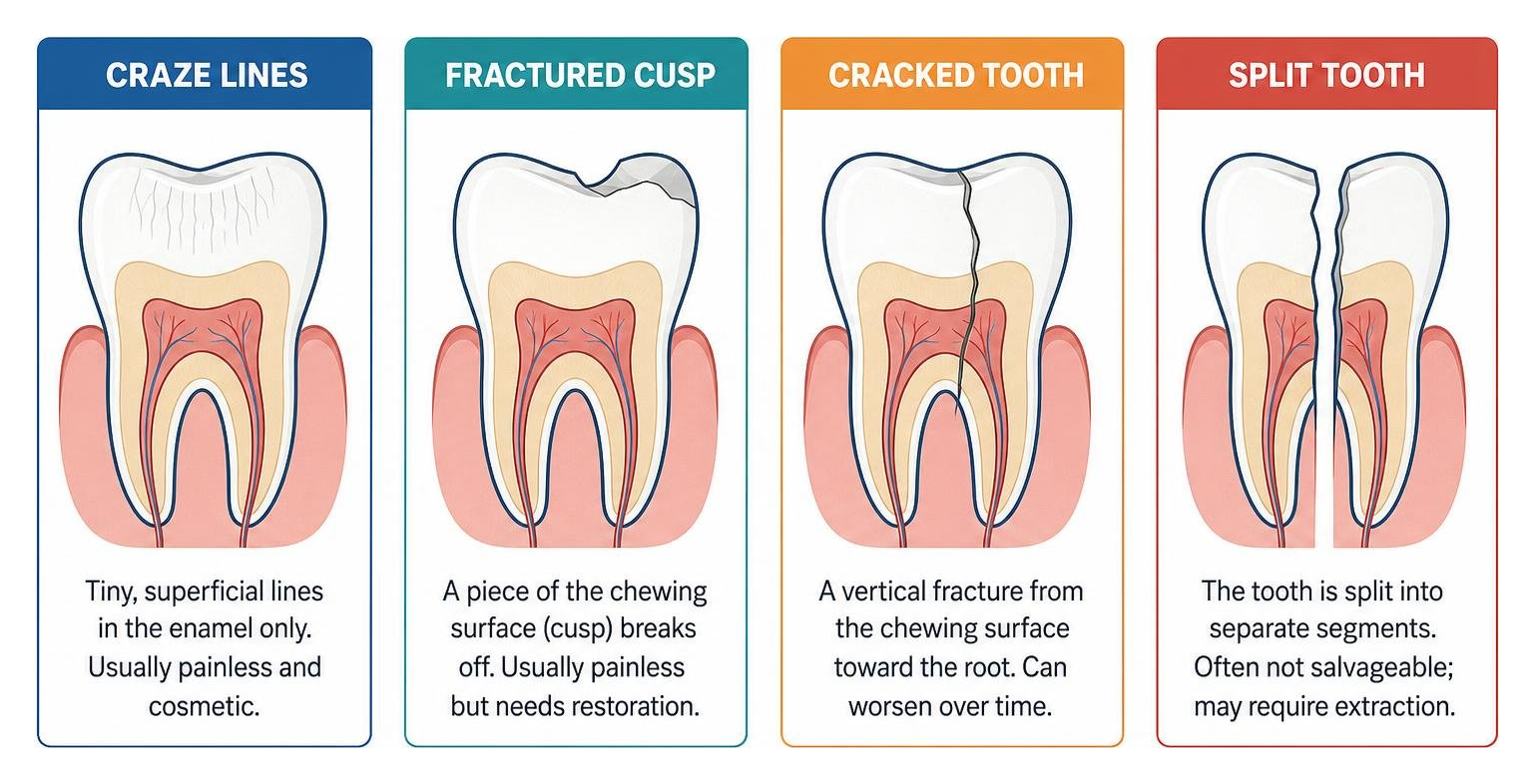
- Craze Lines: These are tiny, superficial cracks that only affect the outer enamel. They are incredibly common as we age and do not cause pain. While they are usually a cosmetic concern, they should be monitored to ensure they do not expand.
- Fractured Cusp: This occurs when a piece of a tooth’s chewing surface (the cusp) breaks off. This type of damage is common around old fillings on back molars. Because it rarely damages the pulp, it is usually painless but requires restoration to restore chewing function.
- Cracked Tooth: This is a fracture line that runs vertically from the chewing surface down toward the root. If caught early, a crown can protect the tooth. If left untreated, the crack can expand, exposing the pulp and eventually leading to tooth loss.
- Split Tooth: Often the result of an untreated cracked tooth, a split tooth has a fracture line that divides the tooth into distinct, separate segments. In most cases, a split tooth cannot be saved in its entirety, though sometimes a portion of it can be preserved.
For a deeper dive into how we evaluate these different types of structural damage, you can read our guide on understanding tooth cracks and chips. For more general clinical information on symptoms and diagnosis, you can also consult the Cleveland Clinic’s resource on Chipped Tooth: Causes, Symptoms & Repair.
Immediate First-Aid Steps After Chipping a Tooth
Discovering a chipped tooth can be shocking, but knowing what to do in the first hour can protect your tooth from further damage, prevent infection, and even make the repair process easier for your dentist.
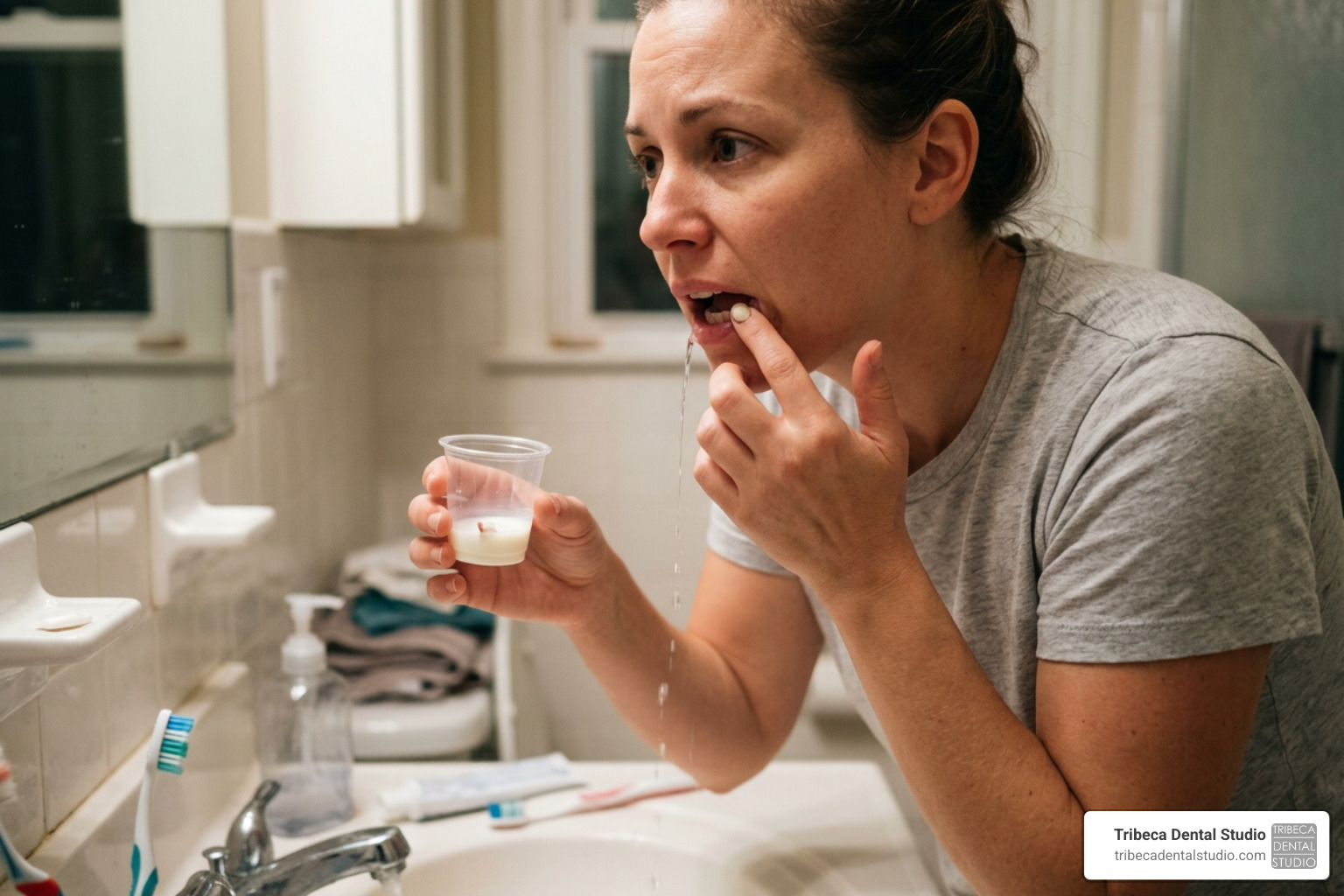
If you have just chipped a tooth, we recommend following these immediate first-aid steps:
- Save the fragment (if possible): If you can find the broken piece of your tooth, rinse it gently in warm water and store it in a small container of milk or your own saliva. In some cases, a dentist can actually reattach the natural fragment.
- Rinse your mouth: Gently rinse your mouth with warm salt water (about half a teaspoon of salt in a glass of warm water). This helps clean the area, remove any loose debris, and reduce the risk of infection.
- Control any bleeding: If your gums or lip are bleeding from the impact, apply gentle pressure with a clean piece of gauze or a damp tea bag for about 10 minutes, or until the bleeding stops.
- Reduce swelling: Apply a cold compress or ice pack wrapped in a cloth to the outside of your cheek or lip near the injured tooth. This is highly effective at keeping swelling and bruising down.
- Protect your mouth from sharp edges: A chipped tooth often leaves behind a sharp, jagged edge that can easily cut your tongue, cheek, or lips. Cover the sharp edge with a small piece of dental wax, temporary filling material from a pharmacy, or even sugarless chewing gum.
- Watch what you eat: Avoid chewing on the side of your mouth with the damaged tooth. Stick to soft foods like yogurt, applesauce, or soup, and avoid extremely hot, cold, sugary, or acidic items that could trigger intense sensitivity.
- Manage pain safely: If you are experiencing discomfort, over-the-counter pain relievers like ibuprofen can help manage the inflammation and pain. Never apply aspirin directly to your gums, as this can cause chemical burns.
- Contact your dentist right away: Even if the chip seems minor and doesn’t hurt, you should schedule an evaluation as soon as possible. What looks like a tiny surface chip could actually be a sign of a deeper structural crack.
For a complete, printable checklist on managing dental trauma at home, check out our comprehensive emergency guide for chipped teeth.
Professional Treatments for Chipped Tooth Enamel Repair
Once you arrive at our Tribeca office, we will take digital X-rays and perform a thorough visual exam to assess the health of your tooth’s root and pulp. From there, we will discuss the best restorative and cosmetic dentistry options to rebuild your smile.
Depending on the size and location of your chip, several professional treatments are available:
Enameloplasty (Tooth Contouring)
For very small, shallow chips that only affect the outermost layer of enamel, we may recommend a highly conservative procedure called enameloplasty. Also known as tooth contouring or shaping, this treatment involves using specialized dental instruments to gently shave down, smooth, and polish away rough or uneven edges.
Enameloplasty is incredibly fast — usually taking less than 30 minutes — and is completely painless because enamel does not contain any nerves. No local anesthesia is required, and the results are instant. However, because enamel does not grow back, this procedure is only suitable for minor cosmetic adjustments where the structural integrity of the tooth is not compromised.
To learn more about the pros, cons, and clinical safety of this shaping procedure, you can read the Cleveland Clinic’s detailed guide on Enameloplasty (Tooth Contouring): Benefits & Side Effects. If you are exploring broader ways to enhance your smile’s symmetry, browse our complete list of cosmetic dentistry options.
Dental Bonding: A Quick Chipped Tooth Enamel Repair
For minor to moderate chips, especially on the highly visible front teeth, dental bonding is often the ideal solution. This conservative treatment allows us to rebuild the missing portion of your tooth in a single visit without having to remove any of your healthy, natural enamel.
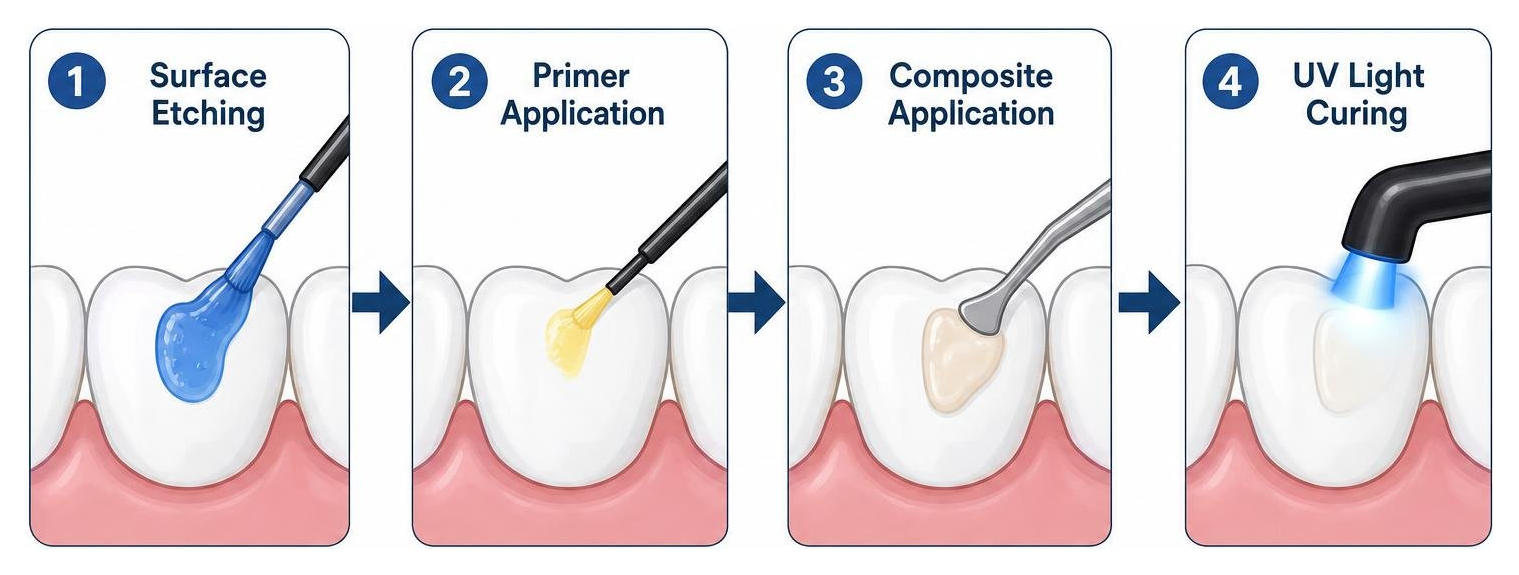
The dental bonding process is straightforward and typically takes between 30 to 60 minutes per tooth:
- Shade Matching: We use a physical shade guide to select a composite resin material that perfectly matches the exact color, translucency, and natural variations of your surrounding teeth.
- Surface Preparation: We gently roughen the surface of the tooth and apply a mild conditioning liquid. This creates microscopic texture on the enamel, helping the bonding material adhere securely.
- Applying the Resin: We apply the soft, putty-like composite resin in thin layers, carefully sculpting and shaping it to replicate the natural contours of your tooth.
- Curing: Once the shape is perfected, we use a specialized ultraviolet curing light or dental laser to instantly harden and bond the resin to your natural enamel.
- Polishing and Bite Check: Finally, we trim, shape, and polish the restored tooth so that it feels smooth to your tongue and shines just like natural enamel. We will also have you bite down to ensure the restoration fits comfortably into your natural bite.
Because bonding is an “additive” procedure, it is entirely reversible and keeps your future cosmetic options open. For a step-by-step walkthrough of what to expect during your appointment, check out our guide to getting a chipped tooth fixed.
Veneers and Crowns for Advanced Chipped Tooth Enamel Repair
When a chip is too large for bonding, or if it occurs on a back tooth that must withstand heavy chewing forces, more advanced restorative treatments are required.
Porcelain Veneers
If you have a significant chip on a front tooth, porcelain veneers offer a stunning, highly durable, and stain-resistant cosmetic solution. A veneer is a custom-made, wafer-thin shell of medical-grade ceramic that is permanently bonded to the front surface of your tooth.
Unlike dental bonding, which can absorb stains over time, porcelain mimics the light-reflecting properties of natural enamel and remains bright for years. Placing a veneer typically requires two visits: one to prepare the tooth and take a digital impression, and a second to bond the custom porcelain shell in place. To see how veneers can completely transform a broken smile, explore our detailed overview of cosmetic options for tooth repair.
Dental Crowns
If a chip is severe enough to compromise more than half of your tooth’s natural structure, or if the tooth has been weakened by a root canal, a dental crown is the best option. A crown is a custom-fabricated “cap” that completely covers the visible portion of the tooth down to the gumline, restoring its natural size, shape, strength, and appearance.
At Tribeca Dental Studio, we use high-quality, metal-free materials like porcelain and zirconia to ensure your crown blends seamlessly with your natural teeth while providing maximum durability.
Root Canals for Pulp Exposure
If a deep chip or fracture exposes the delicate inner pulp of the tooth, bacteria can quickly enter and cause an infection. Symptoms of pulp exposure include sharp pain when chewing, extreme sensitivity to hot or cold temperatures, or a persistent, throbbing ache.
In these cases, a root canal is necessary to save the tooth. During this highly routine, comfortable procedure, we remove the damaged pulp, clean and disinfect the root canals, and seal the space. We then place a custom dental crown over the tooth to restore its structural strength and prevent future fractures.
Cost, Insurance, and Longevity of Enamel Repairs
When planning your chipped tooth enamel repair, it is helpful to understand how different treatments compare in terms of average lifespan, typical recovery times, and dental insurance coverage.
| Treatment Type | Average Lifespan | Typical Recovery Time | Dental Insurance Coverage |
|---|---|---|---|
| Enameloplasty | Permanent (Enamel is reshaped) | None (Immediate) | Rarely covered (usually considered cosmetic) |
| Dental Bonding | 3 to 10 years | None (Immediate) | Often covered (50%-80%) if medically necessary |
| Porcelain Veneers | 10 to 15+ years | 1 to 2 days (mild sensitivity) | Rarely covered (unless repairing structural trauma) |
| Dental Crowns | 10 to 15+ years | 2 to 3 days (mild sensitivity) | Typically covered (50%-80%) as a major restorative treatment |
| Root Canal + Crown | 10 to 15+ years | 3 to 5 days (mild soreness) | Highly likely to be covered as a medical necessity |
Understanding Dental Insurance and Costs
Whether your dental insurance covers your repair depends largely on whether the procedure is classified as “cosmetic” or “restorative” (medically necessary):
- Restorative Repairs: If a chip causes pain, exposes dentin, or compromises the structural integrity of your tooth, treatments like fillings, crowns, and root canals are usually deemed medically necessary. Most dental insurance plans cover a significant portion of these costs.
- Cosmetic Repairs: Elective procedures performed solely to improve the appearance of your smile — such as enameloplasty or veneers for minor, painless chips — are generally not covered by insurance.
Fortunately, many patients can use their Health Savings Account (HSA) or Flexible Spending Account (FSA) funds to cover out-of-pocket costs for medically necessary dental treatments. For a deeper breakdown of variables that influence restoration pricing, you can read our price guide for tooth repair.
Preventing Future Chips and Protecting Your Smile
Once your tooth has been beautifully restored, taking proactive steps to protect your investment and preserve your natural enamel is key to maintaining a healthy smile.
We recommend incorporating these protective habits into your daily routine:
- Wear a custom nightguard: If you clench or grind your teeth at night, a custom-fitted nightguard is your single best defense. It acts as a protective barrier, absorbing the immense forces of bruxism and preventing your natural teeth and dental restorations from chipping or cracking.
- Wear an athletic mouthguard: If you participate in contact sports like basketball, soccer, or martial arts, always wear a professionally fabricated athletic mouthguard to cushion your teeth from external impacts.
- Kick the bad habits: Never use your teeth to open packages, rip tags, or bite your nails. Avoid chewing on non-food items like pen caps, ice, or toothpicks.
- Modify your diet: Be mindful when eating hard foods. Cut hard fruits like apples and pears into slices rather than biting directly into them, and exercise caution with popcorn, bone-in meats, and hard breads.
- Maintain excellent oral hygiene: Brush your teeth twice a day with a soft-bristled toothbrush and fluoride toothpaste, and floss daily. Keeping your enamel clean and mineralized prevents decay, which is one of the leading causes of weakened, brittle teeth.
- Visit us regularly: Routine dental exams and professional cleanings allow us to monitor your restorations, catch early signs of enamel wear or micro-cracks, and address issues before they turn into costly emergencies.
Frequently Asked Questions
Can a single chipped front tooth be repaired without treating the surrounding teeth?
Yes, absolutely! Modern dental materials and advanced shade-matching technology allow us to restore a single chipped front tooth with incredible precision, ensuring it blends seamlessly with your neighboring teeth.
For minor chips, composite bonding is an excellent, conservative option that can be completed in a single visit. If you decide to whiten your teeth, we highly recommend doing so before your repair, as dental composite and porcelain do not respond to whitening treatments. This allows us to match your new restoration to your brightest, most radiant shade. For more information on single-tooth restorations, read our guide on fixing a chipped front tooth.
What happens if you leave a chipped tooth untreated?
Leaving a chipped tooth untreated is highly risky. Even if a chip seems small and doesn’t hurt, the loss of protective enamel leaves the inner structures of your tooth vulnerable.
Over time, plaque and bacteria will accumulate in the rough crevices of the chip, significantly increasing your risk of tooth decay. If the crack expands and reaches the inner pulp, it can lead to a painful nerve infection, a dental abscess, and potentially require a root canal or tooth extraction to resolve. Prompt treatment is always the safest and most cost-effective choice.
Will a repaired chipped tooth look natural?
Yes. Thanks to modern aesthetic dentistry, a repaired tooth can look completely natural.
Whether we use composite resin for dental bonding or custom porcelain for veneers and crowns, we carefully layer different shades and translucencies to mimic the natural depth, color variations, and light-reflecting qualities of your real enamel. Our goal is always to make your restoration virtually invisible, restoring both your dental function and your self-confidence.
Conclusion
A chipped tooth can happen in the blink of an eye, but restoring your smile doesn’t have to be a stressful experience. From simple smoothing to advanced restorative care, modern dentistry offers highly effective, comfortable solutions to bring back your smile’s strength and beauty.
At Tribeca Dental Studio, we are proud to be a leading, trusted dental practice in Tribeca, Manhattan, known for our personalized, family-centered approach to oral healthcare. Under the leadership of Dr. Nina Izhaky, our highly experienced team is committed to delivering predictable, best-in-class outcomes for all of our patients.
Whether you need a quick dental bonding repair, custom porcelain veneers, durable dental crowns, or advanced periodontal care and deep cleanings, we utilize state-of-the-art technology to ensure your comfort. For patients requiring comprehensive rehabilitation, we also offer exceptional expertise in full-mouth reconstruction and advanced implant dentistry—including specialized zygomatic implant care led by our highly experienced specialist, Dr. Sam Morhaim.
We stand behind the quality of our work and are dedicated to helping you maintain a healthy, beautiful smile for life. If you have recently chipped a tooth or want to explore your cosmetic options, we invite you to schedule a consultation for cosmetic dentistry with our welcoming team in NYC today!