
Why Front Tooth Fillings Deserve Special Attention
A front tooth filling is a dental restoration used to repair decay, chips, cracks, or cosmetic imperfections on your visible front teeth — the ones everyone sees when you smile, talk, or laugh.
Quick answers at a glance:
- What it is: A tooth-colored composite resin restoration bonded directly to a front tooth
- Why you might need one: Cavity, chip, crack, worn enamel, or even a small gap between teeth
- Is it visible? No — modern composite fillings are matched to your exact shade and are virtually invisible
- Does it hurt? No — local anesthesia is used; most patients feel nothing during the procedure
- How long does it take? Typically 20–30 minutes in a single visit
- How long does it last? 5–10 years with proper care
Front teeth are different from molars. They’re thinner, more visible, and take a different kind of stress — biting rather than grinding. That means restoring them takes more than just plugging a hole. It takes precision, artistry, and the right materials.
The good news? When done well, a front tooth filling is completely undetectable. Most people who get one are surprised at how quick, painless, and natural the result looks.
I’m Dr. Nina Izhaky, a graduate of New York University College of Dentistry and founder of Tribeca Dental Studio, where front tooth filling restorations are among the most rewarding procedures I perform. My mercury-free, tooth-colored approach means every restoration is built to blend seamlessly with your natural smile.
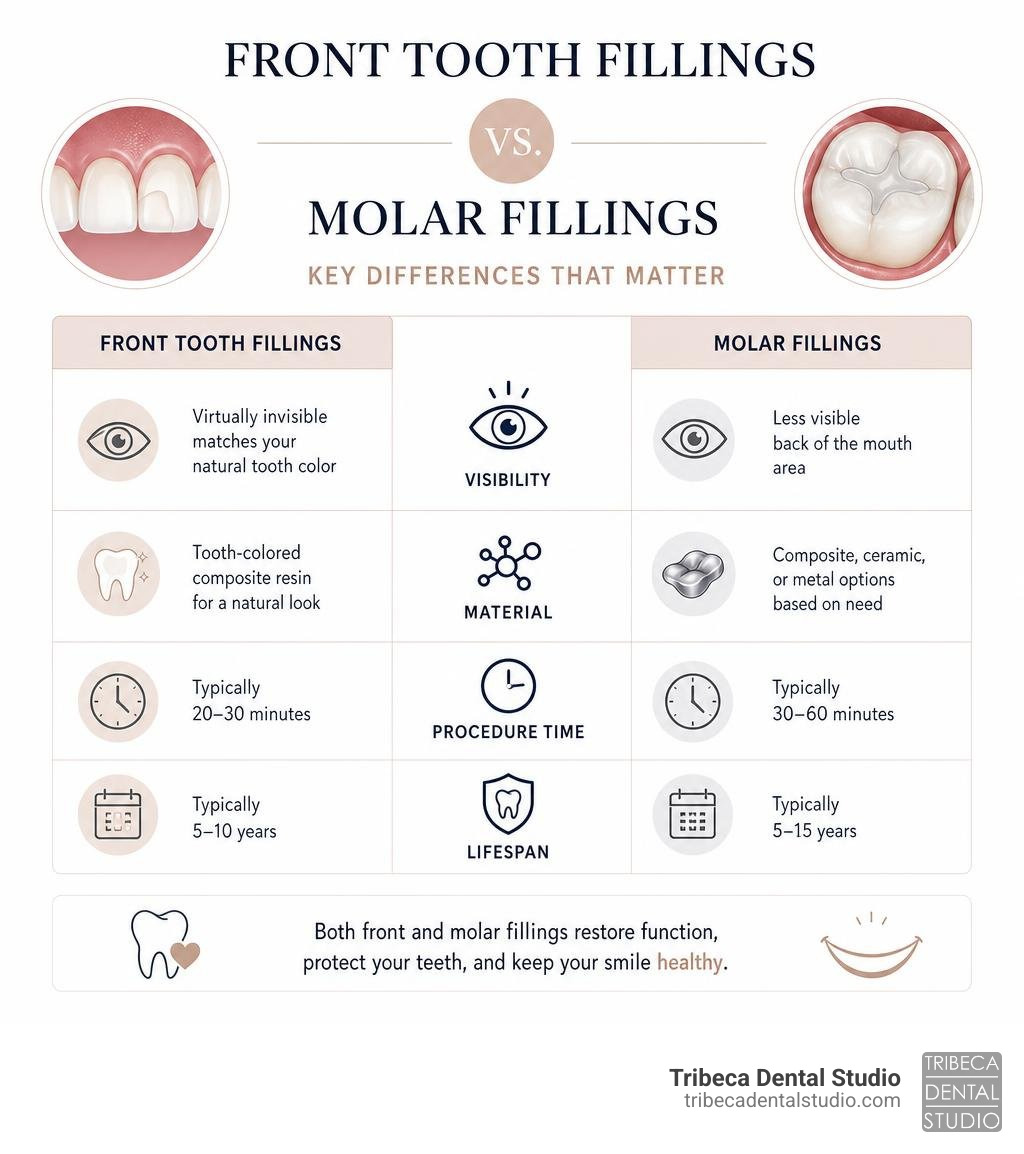
Front tooth filling terms to know:
What is a Front Tooth Filling and Why Might You Need One?
When people think of dental cavities, they often picture the deep, grooved surfaces of their back molars. However, your incisors and canines are also vulnerable to damage. A front tooth filling is a specialized procedure designed to address structural issues in these highly visible teeth while maintaining—or even improving—your smile’s natural beauty.
Unlike back teeth, which are built primarily for heavy chewing and grinding, your front teeth are designed for shearing, tearing, and biting. They also serve as the cornerstone of your facial aesthetics. Therefore, when decay or physical damage occurs here, the restoration must be handled with an artistic touch.
At Tribeca Dental Studio in Lower Manhattan, we prioritize conservative treatments that preserve as much of your natural tooth structure as possible. Placing tooth-colored fillings allows us to rebuild your tooth seamlessly, ensuring that the boundary between your natural enamel and the restorative material is completely invisible to the naked eye.
Beyond treating active decay, these restorations are highly versatile. We regularly use them to correct minor cosmetic issues, such as closing small gaps (diastemas), smoothing out uneven edges, and restoring teeth that have suffered from severe enamel erosion. For general public-health information on how cavities develop, the National Institute of Dental and Craniofacial Research offers a helpful overview of tooth decay.
Common Causes of Front Tooth Damage
How does a front tooth find itself in need of a filling in the first place? While back teeth often decay due to deep grooves that trap food, front teeth are usually compromised by a different set of factors:
- Plaque Buildup and Poor Flossing: The spaces between your front teeth (interproximal areas) are notorious for trapping plaque. If you skip daily flossing, bacteria will quietly erode the thin enamel between these teeth, leading to cavities that often look like small dark spots or shadows when light shines through them.
- Physical Trauma: Because your front teeth lead the way, they are the first to take the impact during sports injuries, accidental trips, or even biting down on an unexpectedly hard piece of food. A minor chip or crack can easily be repaired with a composite restoration.
- Acid Erosion: Frequent consumption of acidic beverages like citrus juices, soda, and sports drinks can wear down the smooth enamel on the front surfaces of your teeth.
- Dry Mouth (Xerostomia): Saliva is your mouth’s natural defense mechanism, washing away food particles and neutralizing acids. A lack of saliva—often caused by certain medications or mouth breathing—accelerates decay on front teeth.
When addressing these issues, we focus on providing comprehensive aesthetic and functional solutions for front teeth to ensure your smile remains both healthy and beautiful.
Common Materials for Front Teeth
When it comes to restoring a front tooth, material selection is everything. You won’t find traditional silver amalgam fillings used here. Not only would a dark metal spot ruin your smile’s aesthetics, but metal fillings also require aggressive drilling to stay in place.
Modern dentistry offers several sophisticated, biocompatible options. To understand the full spectrum of restorative materials, you can explore our detailed guide on common cavity filling materials.
For front teeth specifically, the most common options include:
- Composite Resin: The absolute gold standard for anterior restorations. Made of a mixture of plastic resin and finely ground glass particles, composite resin mimics the light-reflecting properties of natural enamel. It bonds chemically to your tooth, meaning we only need to remove the decayed portion, leaving your healthy tooth structure intact.
- Porcelain/Ceramic: Highly durable and completely resistant to staining, porcelain is used for larger restorations (like inlays, onlays, or veneers). While they require a lab or specialized milling, they offer unmatched translucency and longevity.
- Glass Ionomer: Made of acrylic and a specific type of glass material, these fillings are unique because they release fluoride over time, helping to protect the tooth from future decay. However, they are less translucent and more prone to wear than composite resin, making them ideal for fillings near the gumline or for pediatric patients rather than the biting edges of adult teeth.
Front Tooth vs. Back Tooth Restorations
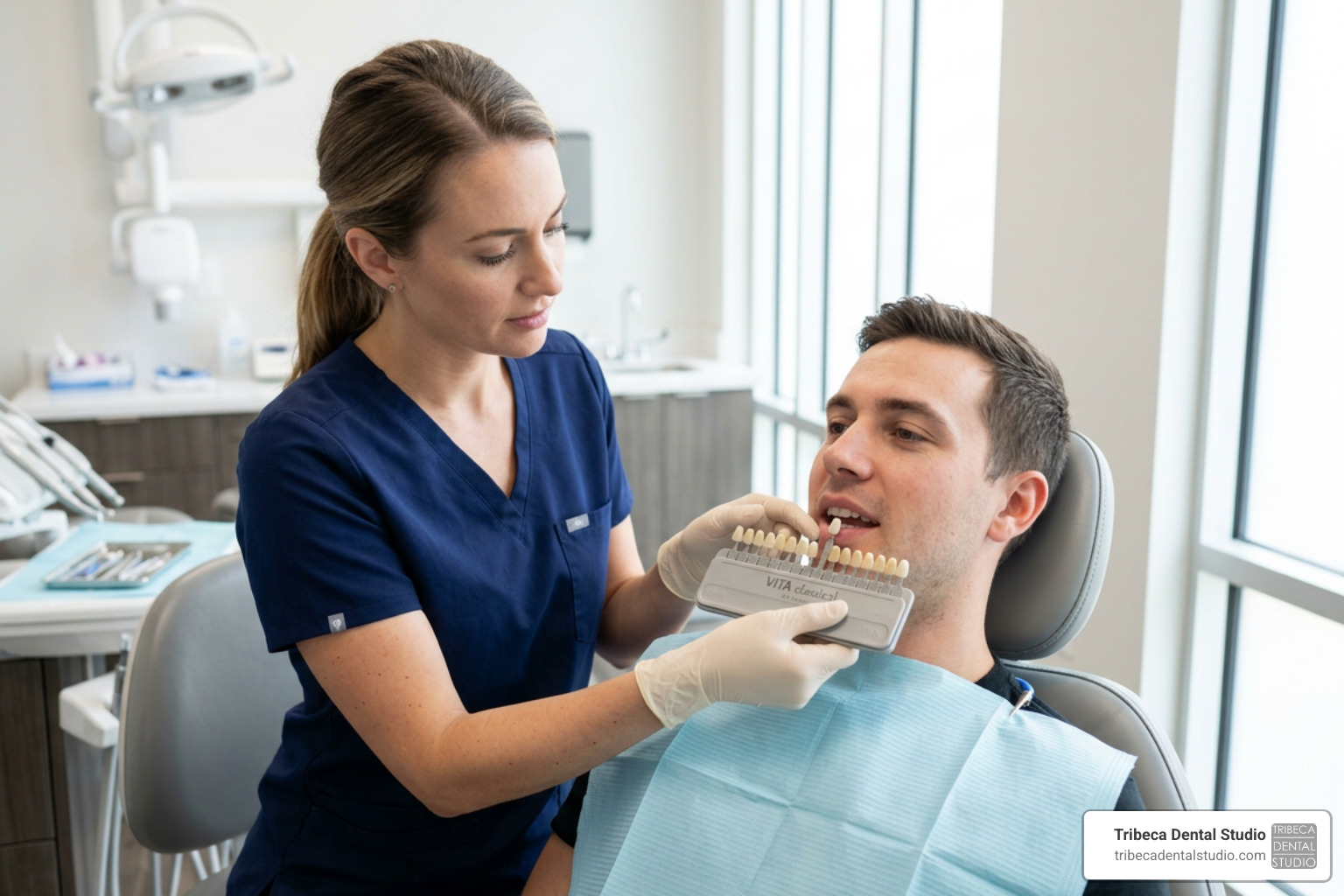
Restoring a front tooth is a fundamentally different task than restoring a back molar. While a molar restoration is all about engineering a structure that can withstand hundreds of pounds of grinding pressure, a front tooth restoration is an exercise in fine art and micro-mechanics.
Because front teeth are so visible, patients have incredibly high aesthetic demands. If a molar filling is slightly off-shade, no one will ever know. If a front tooth restoration is even a fraction of a shade too yellow or too opaque, it can make a patient feel self-conscious every time they speak.
Furthermore, the physical anatomy of front teeth is much more delicate. The enamel layer is thinner, and the teeth themselves are flatter. This means there is less physical volume to work with, requiring a dentist to use highly precise techniques to bond the material securely without encroaching on the tooth’s dental pulp (nerve). When seeking restorative dental fillings in New York, choosing a provider who understands these anatomical nuances is vital to achieving a long-lasting, beautiful result.
Aesthetic Demands and Shade Matching
To make a front tooth filling look completely natural, we don’t just grab a generic “white” material. Natural teeth are not a solid, uniform color; they are highly complex structures with varying gradients of shade, translucency, and light reflection.
The process of matching a composite restoration to your natural tooth involves several artistic steps:
- Pre-Hydration Matching: We always select the composite shade at the very beginning of your appointment. Why? Because as soon as we begin working and your teeth are isolated, they begin to dry out (dehydrate). Dehydrated teeth temporarily appear much whiter than they actually are. Matching the shade first ensures accuracy.
- Layering Techniques: We use a technique called “layering.” Your natural tooth has a deeper, more opaque dentin layer covered by a highly translucent enamel layer. By applying different shades and opacities of composite resin in thin, successive layers, we can recreate this natural depth.
- Mimicking Light Reflection: The incisal edge (the biting edge) of a front tooth often has a blueish, translucent halo. We carefully sculpt the composite to replicate these micro-details so that when light hits your tooth, it bounces off the restoration in the exact same way it does your natural enamel.
Structural and Functional Differences
Because front teeth and back teeth perform entirely different roles in your mouth, the structural demands on their restorations are unique. Front teeth experience “shear stress”—the sliding, pushing forces that occur when you bite into an apple or tear a piece of bread. Back teeth, on the other hand, experience vertical compressive forces from chewing.
Here is a quick breakdown of how these differences impact treatment:
| Feature | Front Tooth Restorations (Anterior) | Back Tooth Restorations (Posterior) |
|---|---|---|
| Primary Stress | Biting, shearing, and tension forces | Heavy vertical chewing and grinding |
| Enamel Thickness | Relatively thin, requiring conservative preparation | Thicker, with deep grooves prone to decay |
| Material Priority | High polishability, translucency, and shade matching | High fracture resistance and wear durability |
| Retention Method | Strong chemical bonding to thin enamel and dentin | Mechanical retention combined with chemical bonding |
| Common Failure Mode | Chipping from biting hard objects or staining | Wear from grinding or structural fracture |
The Step-by-Step Front Tooth Filling Procedure

If you are nervous about getting a cavity filled on a front tooth, take comfort in knowing that this is a highly routine, single-visit procedure that typically takes only 20 to 30 minutes. Because front teeth are highly accessible, the process is often faster and more straightforward than treating a back tooth.
At Tribeca Dental Studio, we believe that your comfort is just as important as the final aesthetic result. We utilize state-of-the-art techniques to provide a painless dental filling experience, ensuring you feel relaxed and completely at ease from the moment you sit in our chair to the moment you walk out into Manhattan with a restored smile.
Preparing for a Front Tooth Filling
The preparation phase is designed to set the stage for a seamless, comfortable procedure. Here is what you can expect during the first half of your visit:
- Shade Selection: As mentioned, we select the perfect composite shades while your teeth are fully hydrated under natural lighting.
- Anesthesia: If the cavity is very superficial and entirely in the enamel, you might not even need numbing! However, for most fillings, we administer a local anesthetic to ensure you don’t feel a thing. Because front teeth have straightforward nerve pathways, the numbing takes effect almost instantly.
- Isolating the Tooth: We use specialized dental dams or cotton rolls to keep the tooth completely dry. Composite resin is highly sensitive to moisture; even a tiny drop of saliva can prevent the material from bonding correctly.
- Decay Removal: Using highly precise, conservative instruments, we gently remove only the damaged or decayed portion of the tooth. To learn more about this step, check out our comprehensive guide on cavity filling 101.
- Etching and Priming: We apply a mild acidic gel to the prepared tooth surface for a few seconds. This creates microscopic pores in the enamel, allowing the bonding agent to grip the tooth securely.
Placing and Polishing the Composite Resin
Once the tooth is prepared and completely clean, the artistic phase of the restoration begins:
- Applying the Bonding Agent: We brush a liquid bonding resin onto the etched surface and use a specialized blue ultraviolet (UV) light to cure (harden) it.
- Layering the Composite: We carefully apply the composite filling material in thin increments. Each layer is meticulously sculpted to match the natural contours of your tooth and then cured with the UV light for about 20 seconds.
- Sculpting the Contours: Using fine dental burs, we refine the shape of the filling, paying close attention to the biting edge and the way the tooth aligns with its neighbors.
- Bite Check: We will have you bite down on a thin strip of carbon paper. This shows us if the filling is catching or sitting too high, allowing us to make micro-adjustments so your bite feels completely natural.
- High-Shine Polishing: The final step is polishing the restoration using a series of ultra-fine polishing discs and paste. This not only gives the filling a beautiful, natural luster but also creates a glass-like surface that resists plaque buildup and staining.
Longevity, Care, and Alternatives for Front Teeth
A high-quality front tooth filling typically lasts between 5 to 10 years. However, its ultimate lifespan is heavily influenced by your daily habits, oral hygiene, and bite alignment.
Unlike natural enamel, composite resin is slightly porous, meaning it can absorb stains over time and is more susceptible to wear from aggressive forces. Understanding the lifecycle of your restoration is key to keeping your smile bright. For a deeper look at when it might be time to refresh your restoration, read our guide on dental filling replacement.
How to Care for Your Front Tooth Filling After the Procedure
Taking care of your new filling doesn’t require a complicated routine, but it does require mindfulness. Because front teeth are highly visible and used for biting, a few simple adjustments can significantly extend the life of your restoration:
- Avoid Biting Hard Objects: Never use your front teeth as tools to open packages, rip tape, or bite your fingernails. Avoid biting directly into incredibly hard foods like ice, hard candy, or whole apples (it’s safer to slice them first!).
- Limit Staining Foods and Drinks: Composite resin can stain over time from frequent contact with coffee, black tea, red wine, dark berries, and tobacco. If you do enjoy dark beverages, consider using a straw and rinsing your mouth with water afterward.
- Maintain Excellent Oral Hygiene: Brush twice a day with a soft-bristled toothbrush and floss daily. Pay close attention to the gumline around your filling, as this is where plaque tends to accumulate and cause “secondary decay” along the margins of the restoration.
- Wear a Nightguard: If you clench or grind your teeth at night (bruxism), the intense lateral forces can easily chip or debond a front tooth restoration. A custom nightguard from Tribeca Dental Studio will protect your investment.
Signs Your Filling Needs Replacement
Over time, even the most meticulously placed fillings will eventually need to be replaced due to natural wear and tear. Keep an eye out for these common warning signs:
- Discoloration at the Margins: If you notice a dark or yellow line forming around the edge of the filling, this often indicates “micro-leakage.” This means the bond between the tooth and the composite has begun to break down, allowing bacteria and stains to seep underneath.
- Chipping or Roughness: If the filling feels rough to your tongue or you notice a small chip along the biting edge, it should be evaluated to prevent further structural damage.
- New Sensitivity: If you suddenly experience sensitivity to hot, cold, or sweet foods in a previously restored tooth, the filling may have cracked or developed a new cavity underneath.
- Feeling “Loose”: If the restoration feels like it shifts slightly when you bite down, treat this as an emergency. If your filling is compromised, consult our emergency guide immediately to protect the inner layers of your tooth.
When to Consider Veneers or Crowns Instead
While a front tooth filling is an excellent, conservative choice for small to moderate damage, it is not always the best solution for extensive structural issues. If a tooth has lost more than 50% of its natural structure, a filling may not be strong enough to withstand biting forces.
In these cases, we may recommend more durable alternatives:
- Porcelain Veneers: If you have multiple chips, deep intrinsic staining, or minor alignment issues across your front teeth, veneers offer a beautiful, comprehensive solution. These thin, custom-made porcelain shells cover the entire front surface of the teeth, offering superior stain resistance and lasting 10 to 15+ years.
- Porcelain Dental Crowns: If a front tooth has undergone a root canal, has a very large cavity, or has fractured significantly, a dental crown is the safest option. A crown completely encases the visible portion of the tooth, restoring its full strength, shape, and appearance.
Frequently Asked Questions About Front Tooth Fillings
Navigating dental care can bring up plenty of questions. Here are some of the most common things patients ask us about restoring their front teeth.
Will my front tooth filling be visible to others?
No, not at all! Modern composite materials are incredibly advanced. By using a sophisticated shade guide and layering different opacities of resin, we can perfectly match the color, translucency, and natural light reflection of your surrounding enamel. Once the filling is sculpted and polished to a high shine, it blends seamlessly. No one will be able to tell you had a cavity filled.
Does getting a filling on a front tooth hurt?
The procedure is virtually painless. We apply a highly effective local anesthetic to fully numb the tooth and surrounding gums before we begin. Because front teeth have straightforward nerve structures, they numb very quickly. If you experience mild temperature sensitivity for a few days after the procedure, this is completely normal and can be managed easily with desensitizing toothpaste.
What should I do if my front tooth filling falls out?
If your filling chips or falls out entirely, don’t panic—but do call your dentist right away. Because front teeth have thin enamel, leaving the inner dentin exposed can quickly lead to sensitivity, new decay, or structural fractures. While you wait for your appointment, keep the area clean, avoid biting on that tooth, and consider using over-the-counter temporary fillings as a brief stopgap.
If you’re curious about the financial side of restorations, you can find a breakdown of average costs and insurance coverage in our composite filling cost guide.
Conclusion
A front tooth filling is the perfect marriage of dental science and fine art. It allows us to stop active decay and restore your tooth’s physical strength without compromising the natural beauty of your smile.
At Tribeca Dental Studio in Manhattan, Dr. Nina Izhaky and our dedicated team are passionate about providing personalized, high-quality care that treats you like family. Whether you need to repair a tiny chip, fill a fresh cavity, or replace an old, discolored restoration, we are here to help you smile with absolute confidence.
Ready to restore your smile with the care and precision you deserve? Schedule a consultation for dental fillings in NYC at Tribeca Dental Studio today!