What Happens During Permanent Crown Placement?
Permanent crown placement is the final step in restoring a damaged tooth with a custom-made cap that fits snugly over the prepared tooth structure.
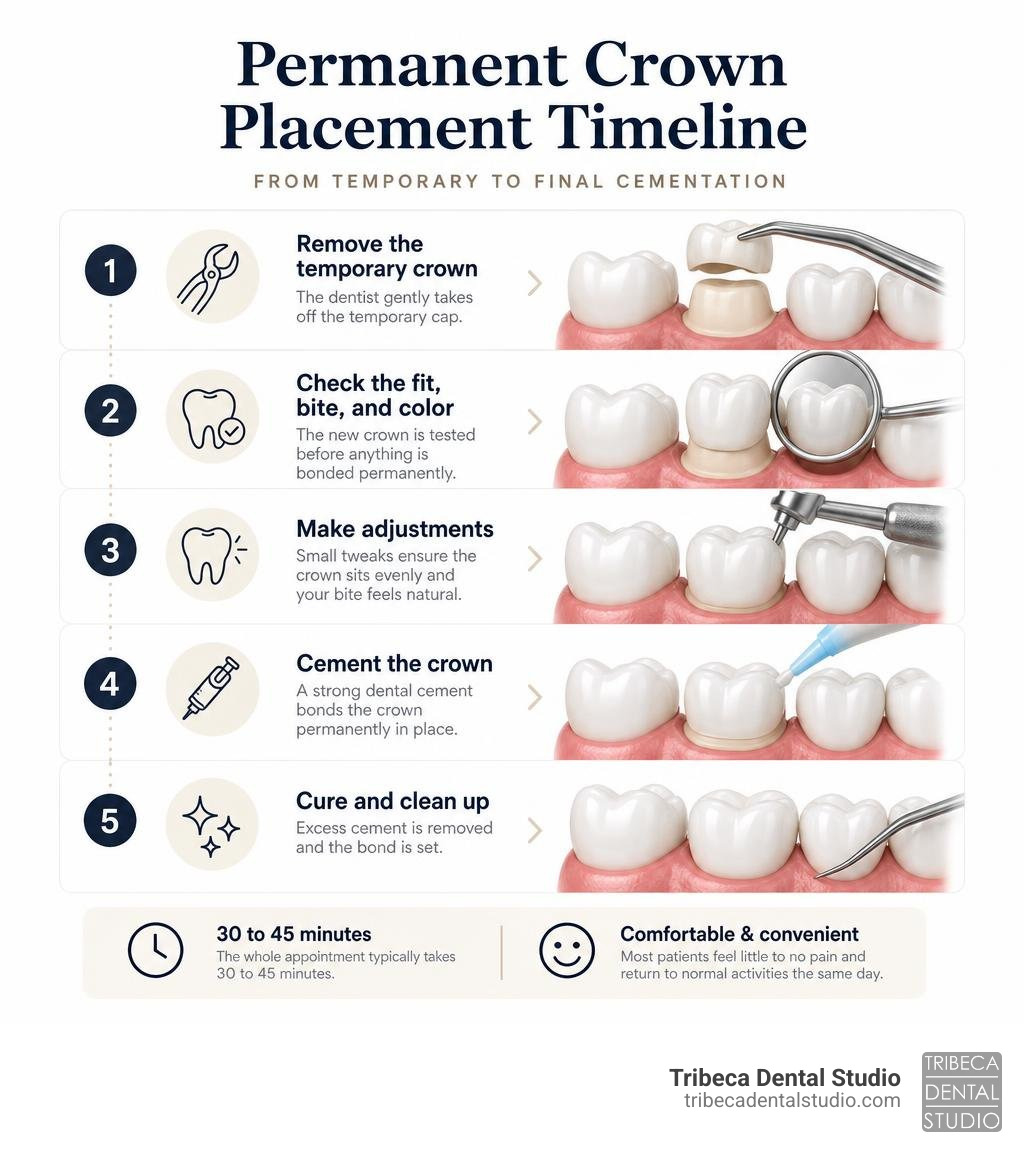
Here is a quick overview of what to expect:
- Remove the temporary crown – The dentist gently takes off the temporary cap that has been protecting your tooth.
- Check the fit, bite, and color – The new crown is tested before anything is bonded permanently.
- Make adjustments – Small tweaks ensure the crown sits evenly and your bite feels natural.
- Cement the crown – A strong dental cement bonds the crown permanently in place.
- Cure and clean up – Excess cement is removed and the bond is set.
The whole appointment typically takes 30 to 45 minutes. Most patients feel little to no pain thanks to local anesthetic, and many return to normal activities the same day.
Think of it like fitting a snug hat onto your tooth. When it sits just right — no gaps, no pressure points, no wobble — you barely notice it’s there. That is exactly the goal.
More than one in four U.S. adults have untreated cavities, and a well-placed crown is one of the most reliable ways to stop further damage and restore full function. With proper care, crowns can last anywhere from 10 to 15 years, and some last well beyond 30.
I’m Dr. Nina Izhaky, a graduate of New York University College of Dentistry and the founder of Tribeca Dental Studio, where I have guided countless patients through permanent crown placement using fully digital, mercury-free techniques. Read on for everything you need to know — from the moment you sit in the chair to caring for your new crown for years to come.
Explore more about permanent crown placement:
What is a Permanent Dental Crown and When is it Needed?
A permanent dental crown is a custom-fabricated, full-coverage restoration designed to act like a protective helmet for a compromised tooth. Unlike a filling, which plugs a hole inside a tooth, a crown completely encapsulates the visible portion of the tooth from the gumline up. This full-coverage design redistributes biting forces, preventing a weakened tooth from flexing, cracking, or breaking under pressure.
When we design Dental Crowns at Tribeca Dental Studio, our primary goals are to restore structural integrity, re-establish natural chewing function, and create a beautiful, seamless look that blends in with your natural smile.
Modern dentistry offers several excellent material options for permanent crowns, each selected based on the tooth’s location, the patient’s bite force, and aesthetic goals:
- Zirconia: Known for its incredible strength, zirconia is a metal-free ceramic that is practically indestructible. It is highly resistant to wear and tear, making it the ideal choice for back teeth (molars) that handle the heavy lifting during chewing.
- Porcelain and All-Ceramic: These materials offer the most natural, lifelike appearance. Because porcelain mimics the translucent properties of natural tooth enamel, it is the gold standard for front teeth (anterior restorations) where aesthetics are the top priority.
- Porcelain-Fused-to-Metal (PFM): This hybrid option features a strong metal interior core covered by a tooth-colored porcelain exterior, offering a balance of durability and aesthetic appeal.
- Gold and Metal Alloys: Though less common today due to cosmetic preferences, gold crowns require the least amount of natural tooth structure removal and are exceptionally gentle on opposing teeth.
Selecting the right material is a collaborative process. We assess your unique bite, the location of the tooth, and your aesthetic goals to help you choose the perfect material for your smile. According to the American Dental Association, dental crowns are an excellent way to restore a tooth’s shape, size, and strength while improving its appearance.
Understanding the Permanent Crown Placement Process vs. Temporary Crowns
The journey to getting a permanent crown usually involves two distinct phases: the temporary phase and the permanent phase. Understanding the differences between these two restorations helps set clear expectations for your treatment.
A temporary crown is a short-term placeholder. It is usually fabricated in our office during your first visit using an acrylic resin or composite material. Because it is bonded with weak, temporary cement, its primary job is to protect the prepared tooth, prevent sensitivity, and keep the surrounding teeth from shifting while the laboratory custom-crafts your final restoration.
In contrast, your permanent crown is built for the long haul. It is fabricated using highly durable materials like zirconia or high-grade porcelain, which can withstand decades of daily chewing forces. If you are looking to skip the temporary phase altogether, advanced CAD/CAM technology allows modern practices to offer same-day restorations, providing a convenient alternative to traditional multi-visit procedures.
| Feature | Temporary Crown | Permanent Crown |
|---|---|---|
| Primary Material | Acrylic resin or PMMA composite | Zirconia, porcelain, PFM, or gold alloy |
| Lifespan | 2 to 6 weeks | 10 to 30+ years |
| Adhesive Used | Weak, temporary cement (easy to remove) | Permanent resin or glass ionomer cement |
| Primary Purpose | Protects prepared tooth and maintains space | Restores full chewing strength and final aesthetics |
| Care Required | Avoid sticky/hard foods; slide floss out sideways | Brush and floss normally after the first 24 hours |
Clinical Indications: From Root Canals to Large Fillings
When does a tooth transition from needing a simple filling to requiring a full-coverage permanent crown? The general rule of thumb is structural integrity: if more than 50% of the tooth’s natural structure is compromised by decay or physical damage, a filling is no longer a safe, predictable option.
Common clinical indications for a permanent crown include:
- Protecting a Tooth After a Root Canal: A root canal-treated tooth is essentially hollowed out, making it brittle and prone to fracturing under normal chewing pressure. Placing a permanent crown is crucial to reinforce the tooth’s structure. You can read more about this recovery process in Root Canal Recovery: Do You Need a Crown After All?.
- Restoring a Cracked or Fractured Tooth: Cracks can spread deep into the tooth’s root system if left unsupported. A crown acts like a tight band, holding the tooth together and preventing the crack from propagating.
- Replacing Large, Failing Fillings: Over time, large fillings can weaken the surrounding tooth walls, leading to micro-fractures. Transitioning to a crown restores the tooth’s structural integrity. Read more about this scenario in Dental Crown After Filling.
- Severe Wear and Tear: Severe acid reflux, grinding (bruxism), or a highly acidic diet can wear down enamel to the point where a crown is required to restore height and function.
Step-by-Step Guide to Your Permanent Crown Placement Appointment
The second appointment—the permanent crown placement visit—is highly anticipated. It is the moment you transition from a delicate temporary cap to a strong, beautiful, fully functional tooth. This appointment is highly streamlined, focused on precision, comfort, and achieving a perfect fit.

Understanding the step-by-step placement process helps eliminate any lingering dental anxiety, allowing you to feel completely relaxed and prepared for your visit.
Preparing the Tooth and Removing the Temporary Cap
The first step of the appointment is removing the temporary crown. Because the temporary cap was placed using weak, temporary cement, this process is usually quick and straightforward. We use specialized, gentle dental instruments to grasp the temporary crown and pop it off with light pressure.
Once the temporary crown is removed, we thoroughly clean the prepared tooth structure. Any leftover temporary cement is carefully scaled away, and the tooth is sanitized. This step is crucial because even a tiny speck of old cement can prevent the new permanent crown from seating fully, which could ruin the fit and throw off your bite.
Checking the Fit, Bite, and Color of Your New Restoration
Before any permanent adhesive is applied, we perform a thorough “try-in” phase. This is where the science of dentistry meets the art of cosmetic restoration. We place the permanent crown onto your tooth and evaluate several critical factors:
- Marginal Fit: We verify that the edge of the crown meets the tooth structure perfectly, leaving no gaps or ledges where plaque and bacteria could accumulate.
- Proximal Contacts: We slide dental floss between the new crown and the adjacent teeth to ensure the contact points are snug. If the contact is too loose, food will trap there; if it is too tight, you will have trouble flossing.
- Occlusion (Bite): We have you bite down on thin, colored articulating paper. This paper marks where your teeth touch. We look for “high spots” where the crown might be hitting too hard, and we make micro-adjustments to ensure your biting forces are distributed evenly.
- Aesthetics: We check the color, shape, and translucency of the crown in natural light to ensure it blends seamlessly with your surrounding teeth.
The Final Bonding: Types of Dental Cement Used
Once you and the dentist are completely satisfied with how the crown looks, feels, and bites, it is time for the final bonding. The choice of cement depends heavily on the crown material and your specific clinical needs:
- Resin Cements: These are highly advanced, tooth-colored adhesives that form a molecular bond between the tooth and ceramic or zirconia crowns. They offer exceptional strength and are highly aesthetic.
- Resin-Modified Glass Ionomer (RMGI) Cements: Often used for metal-based or zirconia restorations, RMGI cements release fluoride over time, which helps protect the underlying tooth structure from recurrent decay.
We apply the cement inside the crown, seat it firmly onto your prepared tooth, and use a special curing light to activate and speed up the chemical bonding process. Once the cement is set, we carefully remove every trace of excess adhesive from around your gums and between your teeth to prevent irritation.
Post-Operative Care: What to Expect After Placement
Once your permanent crown is securely bonded, you can walk out of our Tribeca office and show off your restored smile. However, because the surrounding gum tissue was handled during the removal of the temporary and the placement of the final crown, a brief transition period is completely normal.
The First 24 to 48 Hours: Diet and Oral Hygiene Restrictions
While modern dental cements cure very quickly, they continue to mature and reach their maximum strength over the first 24 to 48 hours. To protect your investment during this critical window, follow these simple guidelines:
- Wait to Eat: Do not eat or drink anything hot until your local anesthetic has completely worn off. Biting your tongue or cheek while numb is a quick way to turn a successful dental visit into an uncomfortable week!
- Stick to a Soft Diet: For the first 24 hours, enjoy soft foods like yogurt, pasta, smoothies, mashed potatoes, and soup. Avoid extremely hard, crunchy, or sticky foods (like caramel, taffy, or ice) that could stress the fresh bond.
- Modify Your Flossing Technique: You should absolutely continue to brush and floss your teeth. However, for the first 48 hours, when flossing around the new crown, gently slide the floss down into the space, clean the area, and then pull the floss out through the side rather than snapping it straight back up. This prevents pulling upward on the newly cemented crown.
Managing Post-Placement Sensitivity and Discomfort
It is very common to experience mild sensitivity or gum tenderness for a few days following permanent crown placement. Your gum tissue may be slightly irritated from the clean-up of the cement, and the nerve inside the tooth may react to the pressure of the procedure.
If your crown is sensitive to hot or cold temperatures, do not panic. This is usually a temporary response to the dental materials and the preparation process. You can read more about managing this in Crown Sensitive to Cold and Hot.
Mild, over-the-counter pain relievers like ibuprofen or acetaminophen are usually more than enough to manage any minor post-op soreness. If you experience sensitivity that worsens over several weeks, or if you feel sharp pain when biting down, contact us so we can evaluate your bite.
Frequently Asked Questions About Crowns
How long does the permanent crown placement procedure take and does it hurt?
The appointment for placing your permanent crown is highly efficient, typically taking only 30 to 45 minutes.
Because the tooth preparation was completed during your first visit, this second appointment is much less invasive. In many cases, local anesthesia is not even required because the temporary crown removal and cementation process are completely painless. However, if your tooth is highly sensitive, or if you feel any anxiety, we can easily numb the area with a local anesthetic to ensure you are 100% comfortable throughout the process.
How long do permanent crowns typically last?
On average, a well-maintained dental crown lasts between 10 and 15 years. However, with meticulous home care and regular professional cleanings, high-quality materials like zirconia and gold can easily last 20 to 30 years or more.
To maximize the lifespan of your crown, treat it like a natural tooth: brush twice a day, floss daily, avoid using your teeth as tools (no opening plastic packaging with your teeth!), and wear a custom nightguard if you clench or grind your teeth at night. For more details on the financial and practical aspects of crown longevity, see Dental Crown Cost: Average Prices and Insurance Tips.
What signs indicate my crown needs adjustment or replacement?
While permanent crowns are incredibly durable, they are not completely indestructible. You should contact us if you notice any of the following warning signs:
- A “High” Bite: If your new crown feels like it is hitting first when you close your mouth, your bite needs a minor adjustment. A high bite can bruise the ligament around the tooth, causing significant pain over time.
- Pain Years Later: If a crowned tooth begins to hurt years after placement, it could indicate recurrent decay at the margin or a root infection. Learn more about this in Why Does a Crowned Tooth Hurt Years Later? Causes, Symptoms and Treatments.
- Movability or Looseness: If you feel the crown click or shift when you chew, the cement bond may have compromised, requiring immediate professional attention to prevent decay underneath.
Conclusion
At Tribeca Dental Studio, we believe that restorative dental care should be highly precise, predictable, and completely stress-free. Led by Dr. Nina Izhaky, our warm and welcoming Manhattan practice treats every patient like family, combining advanced dental technology with a highly personalized approach to care.
In addition to state-of-the-art crown restorations, Tribeca Dental Studio is highly regarded as a leading practice in Tribeca for advanced implant dentistry and zygomatic implant care. Our highly experienced team, which includes renowned specialists like Dr. Sam Morhaim, is dedicated to predictable, high-success outcomes for even the most complex dental reconstructions. We utilize the finest materials, stand behind the quality of our work, and are committed to helping you maintain a healthy, beautiful smile for life.
Whether you need a single permanent crown to protect a cracked tooth or are exploring comprehensive implant solutions, we are here to help.
(Fun fact: While we are experts at fitting the perfect crown to your tooth, if you are looking to visit NYC’s other famous crown, you can check out our guide on the Crown Jewels of NYC: How to Access the Statue of Liberty’s Crown!)
Ready to restore your smile’s strength and confidence? Schedule a consultation for Services: Dental Crowns & Bridges with our trusted team at Tribeca Dental Studio today!